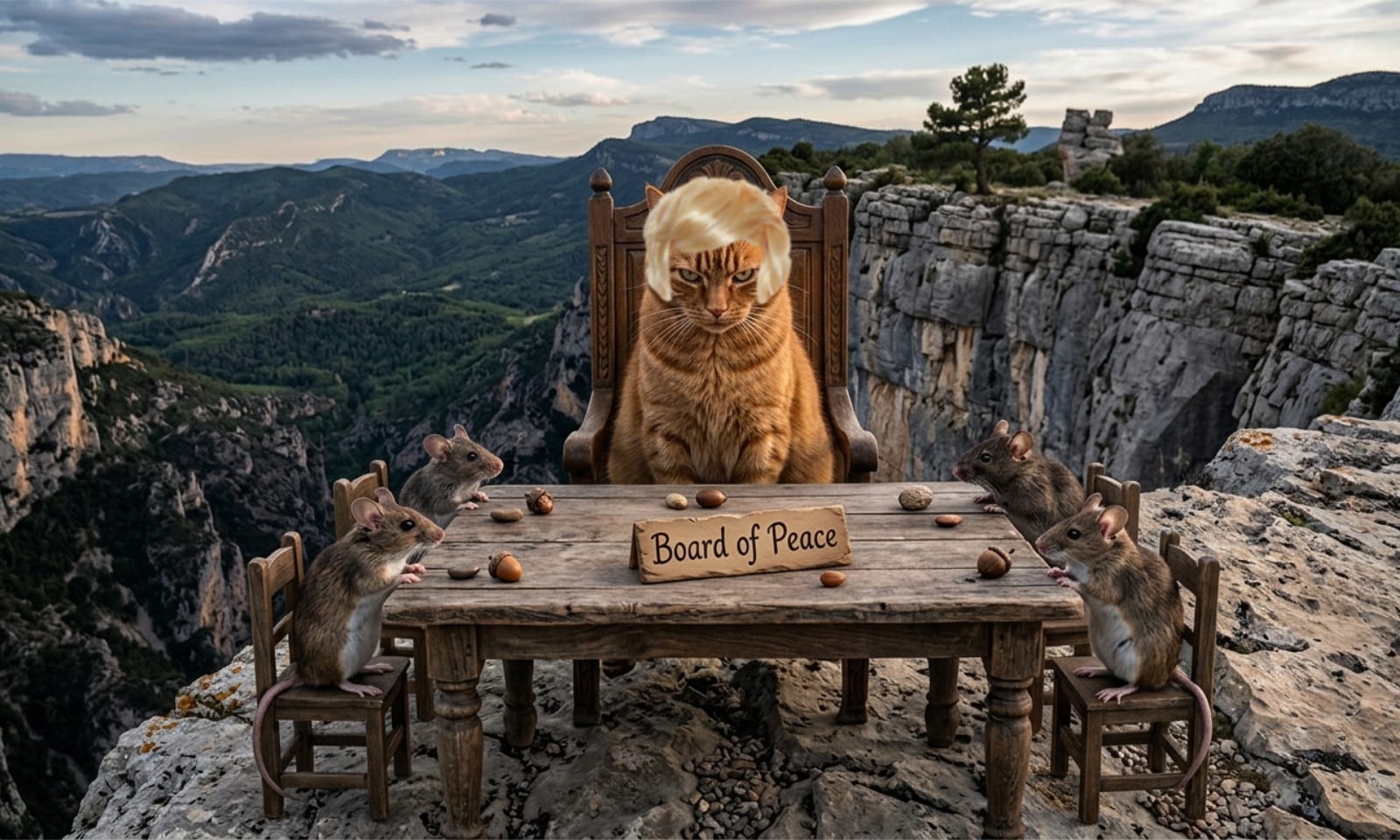
The Board of Peace was to be chaired by Donald J. Trump and its membership would be determined by his preferences and invitations.


On November 17, 2025, the United Nations Security Council passed Resolution 2803, authorizing a Board of Peace to deploy an International Stabilization Force in the Gaza Strip. The resolution welcomed Trump’s Comprehensive Plan to End the Gaza Conflict and had that plan appended to it as Annex 1. The membership of the Security Council includes five permanent members: the United States, the United Kingdom, France, Russia and China; and ten temporary members. In November 2025 the temporary members were Denmark, Greece, Pakistan, Panama, Somalia, Bahrain, Colombia, the Democratic Republic of Congo, Latvia, and Liberia. Permanent members have the power to veto a resolution they oppose. Resolution 2803 passed 13 – 0, with Russia and China abstaining; three permanent members and all temporary members voted in favour.
The Board of Peace was to be chaired by Donald J. Trump and its membership would be determined by his preferences and invitations. The stabilization force for Gaza was to operate consistent with international law, including international humanitarian law, and its role in Gaza was understood to be transitional. Presumably enthusiasm for this resolution was due to its following the ceasefire in the Hamas/Israel war negotiated by President Trump, Marco Rubio and their associates Steve Witkoff and Jared Kushner.
On January 22, 2026, Donald Trump announced the formation of a Board of Peace at the sidelines to the 56th World Economic Forum in Davos, Switzerland. He proclaimed it the greatest and most prestigious board ever assembled. Members were to include leaders of some sixty countries including Argentina, Hungary, Saudi Arabia, Turkey, and Pakistan. There are no Palestinians. Benjamin Netanyahu was invited to join, as was Vladimir Putin. For permanent membership on this board, a state would be required to pay one billion dollars.
Invited but not signing up were the U.K., Norway, Brazil, Sweden, Slovenia, Spain, and France. Apparently piqued by France’s refusal, Trump threatened to impose a 200% tariff on French wines if the country held back. Canada had been invited but that invitation was withdrawn after Prime Minister Carney spoke out pointedly in Davos against bullying and coercion in affairs of trade, decrying a rupture in a rule-based international order. Donald Trump is to be chair of the Board of Peace indefinitely and is to have authority over its membership. The Charter envisages votes on policy matters, though decisions made by members states voting are “subject to the approval of the Chairman.”
Prospects for peace under the guidance of this Board seem unpromising. The Guardian called the Board of Peace a pay to play club, al Jazeera said it was a rogue’s gallery; it has also been deemed a vanity project, and a billionaire’s club. One might suppose that this Board or something like it was authorized by the United Nations, given the existence of United Nations Resolution 2803. But given its significantly wider mandate, such an interpretation is not plausible.
Resolution 2803 was transitional (until the end of 2027) and specifically for Gaza. The Charter of Trump’s Board of Peace has no such restrictions in time or territory. Its preamble states that “durable peace requires pragmatic judgment, common-sense solutions, and the courage to depart from approaches and institutions that have too often failed.” One has to wonder who would be claiming this pragmatic judgment. Are there ideals relating to peace from which pragmatism requires departure? What are the institutions said to have too often failed? The Charter states the need for “a more nimble and effective international peacekeeping body.” More nimble and effective than what, one might ask? Should one always act fast for peace? One might need time to identify helpful local agents or learn relevant historical facts. (Or perhaps not.)
The Charter allows for efforts to promote stability, restore dependable and lawful governance, and secure enduring peace in areas affected or threatened by conflict. This mandate is apparently worldwide and dangerously broad. Conflict in various forms, not all violent, is an inevitable aspect of human life. If even the threat of conflict could allow initiatives by the Board of Peace, the Board could claim a mandate to be anywhere doing just about anything. The Charter does not specify that the Board will be temporary.
Donald J. Trump is to be its chairman and designate his own successor. Issues regarding the meaning, interpretation, and application of the Charter are to be settled by the chairman, who has final authority on such matters. The chairman could voluntarily resign or be replaced due to incapacity, which would require a unanimous vote of an Executive Board composed of leaders of global stature who had been selected by the Chairman.
What will this Board be likely to do, with Trump having sweeping authority and likely to be dominant even after he ceases to be president of the United States? Some have worried that it might seek to replace the United Nations. There are many matters for speculation here. What sorts of interventions could the Board’s broad mandate legitimize or seem to legitimize? Would a context in which some citizens supported a Trump-friendly policy and others did not count as one of conflict or threatened by conflict? How about a country threatened in which sub-units threatened separatism? Or one separated from the United States by an ‘unnatural’ border, a large territory that might not be a country at all? Would Trump seek to dominate global politics through the Board of Peace? Could he use the Board in such attempts? Is there a real possibility of the Board replacing the United Nations, as some commentators have feared?
As I struggled to reflect on various ominous possibilities, I was struck by a shortcut that would assist my reasoning. The structure of the Board of Peace is designed to allow Trump’s domination. That is to say, the Board of Peace is designed to allow and facilitate domination by a power-seeking bully. From his past actions and interventions, we know quite a lot about Donald Trump, the bully king, what he wants to do, and what he does. He lies, making him impossible to trust. He seems oblivious to facts. He makes categorical pronouncements, finding no need to support frequently outlandish claims with evidence. His rhetoric is harsh, full of insults, often intended to humiliate. His calls to prosecute his enemies suggest he conceives of justice as retribution. He insists on loyalty from colleagues and associates but does not always give it in return. He frequently changes his mind and backs off commitments as it suits him, making him extremely unreliable. Self-aggrandizing, unabashed about seeking praise, prizes, and monies for himself and his family, he apparently conflates the interests of his country and its citizens with his personal interests. Donald Trump displays little respect for U.S. law except insofar as it allows him to sue his critics and prosecute his ‘enemies.’ He shows disrespect for sovereignty, human rights, international law, and respected international agreements and practices.
Lying, manipulation, promise-breaking, insulting, humiliating, bullying. These have been characteristic practices of Donald J. Trump, now the chairman of an international Board of Peace. These grossly negative moral features characterize Trump’s policies and actions. Clearly, they are inconsistent with the pursuit of peace. Yet this is what Donald J. Trump supports and pursues. This is what fear, intimidation, and sycophantic obeisance have allowed him to get away with in his second term as U.S. President. We can infer from past practice that this kind of behavior will continue and will characterize the actions and policies of a Board of Peace dominated by Donald J. Trump. This conclusion is more than a matter of speculation; it is based on bitter experience and sordid solid facts.
Clearly lying, untrustworthiness, greed and bullying provide no basis for sustainable peace. Instead, they are reasons to fear for our future. 
The text of United Nations Security Council Resolution 2803 may be found in the United Nations Digital Library. (S-RES-2803-(2025)-EN.pdf. The full text for the Charter for Trump’s Board of Peace has been made available by the Times of Israel. (https://www.timesofisrael.com).