

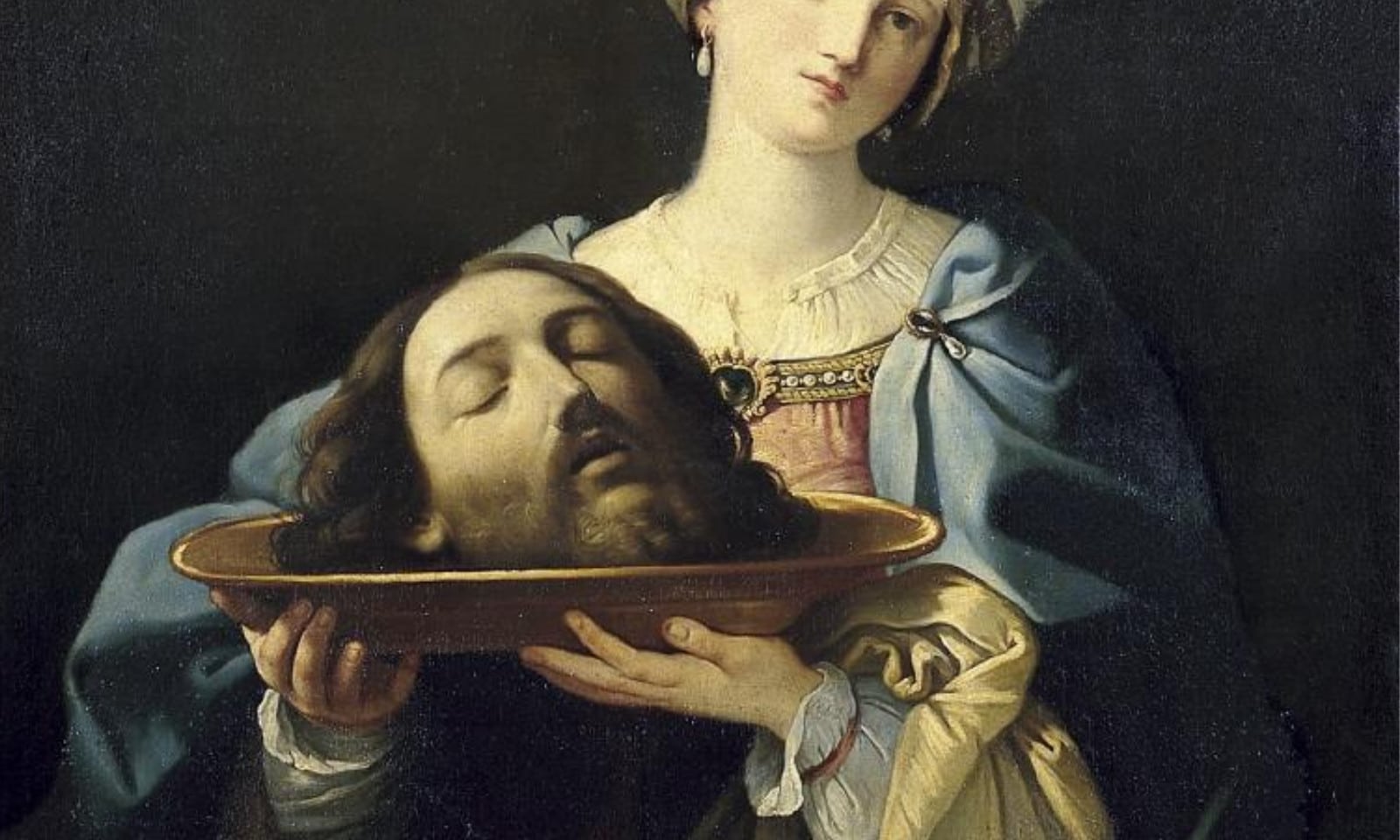
For those who take interest in biblical women, a closer look at their presence in the Bible provides interesting—if troubling—revelations.


The Bible is no place for a woman.
That may seem like an odd statement in a time like now, when Christian nationalism appears to be roaring back with a vengeance and wholesome, homespun tradwife TikTokers are advocating for women to embrace their scripturally mandated roles as dutiful mother and obedient housekeeper/spouse.
After all, the world that gave us the Bible was unmistakably a man’s world, as both its proponents and critics can readily agree. For those who take interest in biblical women, a closer look at their presence in the Bible provides interesting—if troubling—revelations. For example:
- One Christian open-source dataset1 of people, places, and events throughout the Bible, currently lists 3,070 different biblical characters (including unnamed people, angels, demons, and the three members of the Trinity). Of these, 2,866 (over 93%) are male, and 202 (less than 7%) are female.
- The overwhelming majority of women in the Bible are anonymous. Most unnamed women are identified simply by their relation to a man (e.g., “someone’s wife,” or “so-and-so’s concubine”).
- For roughly every 10 men named in scripture, only 1 woman is named.
Of the thousands of named characters, only about 90 to 200 women get specifically named. The exact numbers depend on how overlapping stories and varying translations are counted, but no matter how you tally them, the percentage of these named female characters compared to all named characters is under 15%. - Of these, another widely cited study2 found that only 49 of these named women have recorded dialogue, and these are mostly title characters like Ruth and Esther, or close relatives of famous biblical men (such as Moses’ sister Miriam; or Jesus’ and John the Baptist’s mothers, Mary and Elizabeth). Even so, the speaking roles of these significant named women make up no more than roughly 1.1% of the entire Bible’s text.
Those of us unsurprised by these facts may be rolling their eyes, thinking, Well of course the Bible is sexist! Tell me something I don’t know… But you’re in luck.
As authors Karis Burkowski and David Fitzgerald note, the Bible is clearly not written with women in mind, nor it is particularly divine—and it is arguably not the work of respectable, thoughtful, gentlemen scholars; hence the title of their provocative new book: Clearly Written by Boys: A Woman’s Guide to the Bible.
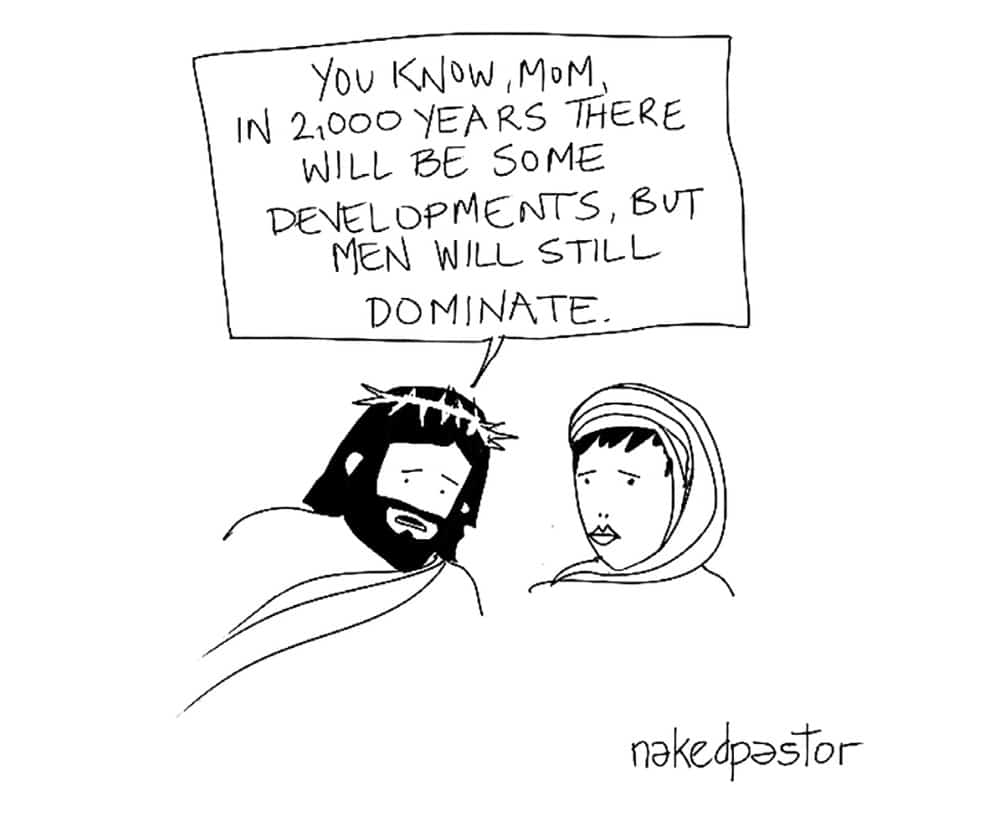
Their book is that rare creature: a serious read that’s also fun and accessible, expertly researched and containing plenty of surprises for believers and nonbelievers alike. It’s also presented in a way that’s as entertaining as it is informative, with 65 drawings by famed cartoonist (and ex-minister) David Hayward, better known as the NakedPastor; beautiful portraits of Biblical women by artist Kat Hardy; and moving works by Pushcart Prize-winning Belgian-American poet Danielle Coffyn and Australian singer-songwriter Shelley Segal.
Unto You A Book is Born
Although Karis is from Ontario and David a San Franciscan expat living in northern California, the two met in 2023 at the BAHACon3 Canadian humanist event, when everyone in attendance was still reeling from the Dobbs decision that overturned Roe v. Wade and stripped women’s reproductive rights and freedoms in the U.S.
Both were already authors of books on the history of religion, so naturally it didn’t take long for them to realize they had a lot to say about the Christian theology undergirding the current backlash against women’s rights. It wasn’t just that the worst elements of Evangelical Christianity were putting a toxic fundamentalist spin on their interpretation of scripture: the sexism and misogyny had been an integral part of Christian scriptures all along.
With a refreshing blend of compassion and tough love, sly humor and deadly seriousness, the two lovingly unpack how the Bible repeatedly betrays its bias against women: in the stories it tells about women, in the way it gets women’s issues wrong, and even simply in its overall disinterest in women and indifference to their thoughts, wants and needs. They also show the Bible’s stories did not come about by accident; nor are they just dispassionately recording objective historical events; they were crafted by aspiring theocrats with deliberate care to accomplish particular social goals, and to create a hierarchy with themselves at the top.
Our authors ask what the Bible would look like if women mattered—really mattered—to the authors that wrote our scriptures? Not just the queens and concubines, harlots and handmaidens, and barren women in need of a son’s miraculous birth; not just the unnamed mothers, wives and daughters; but all women?
“Imagine a Bible (or a Torah, or Qur’an) written by and for women, one that reflected women’s concerns, interests, and fears. What stories and characters would be found in a holy book like that? How do you think those stories would read, and what lessons would those scriptures have for us? What if the women of the Bible could tell us their stories themselves, in their own voices?”
Listening to the Women of the Bible
Burkowski and Fitzgerald do more than simply imagine it. The book’s opening set piece is a series of retold bible stories featuring some of the most beloved—and most hated—women in the Bible, all brought to life in striking portraits by artist Kat Hardy. Accompanying each story is a commentary essay that provides further context and deeper insights. Each story is scrupulously faithful to the biblical original, albeit with one notable difference: they are told from the woman’s point of view. And that singular tweak changes everything.
The women brought to life in these familiar but recast tales have long been portrayed as beautiful examples to be followed, or as villains to be despised. But closer examination of these, and other femmes fatales lurking in holy scripture, reveals that Jewish and Philistine women alike employ the same sexual tactics of seduction and betrayal. It quickly becomes apparent that often the only real difference between a biblical heroine and a biblical villainess comes down to their ethnicity—and whether they were properly obedient to male authority, or defiantly self-willed…
Indifference, Ignorance, & Inaccurate Information: The Bible on Women’s issues
Turning from retelling biographical stories, Burkowski and Fitzgerald follow with an incisive and critical look at the Bible’s appalling track record on a variety of topics crucial to women’s health and well-being.
For example, “Bloody Women!” points out that male fear and disgust towards menstruation is codified throughout God’s commandments about female uncleanness; while men’s blood is held up as the highest and most sacred sacrificial offering imaginable. Our authors counter with Gloria Steinem’s classic spot-on imagining of how things would be (hilariously) different “If Men Could Menstruate.”
The wide range of the Family Values section covers the biblical rules for everything from Marriage to Divorce; and incidentally asks, “If God’s perfect plan for marriage is one man plus one woman, no exceptions, as evangelicals constantly and loudly proclaim to us, then why is it that almost no one in the Bible actually follows that eternal plan?”4
It also does a deep dive into the punishment a woman would undergo for Adultery (or for the mere unproven accusation of adultery)—the deliberate cruelty and humiliation of the not-infrequently-fatal Sotah ritual.
Who owns your daughter’s body? The section regarding Women as Property asks this and other disturbing questions relating to God’s laws directed at men concerning slavery, concubines, and which of your close female relatives you are permitted to have sex with.
The biblically-ordained answers are not comforting or easy to rationalize, no matter how desperately apologists try to hand-wave away the distressing truth about their own holy writ.
Things don’t get any prettier when the book examines why the Old Testament authors are so pathologically obsessed with (female) virginity (“Your Hymen or Your Life: Virginity & Purity Culture”) and how that perverse mindset is still going strong today in the abstinence-only sex education, Daddy-Daughter promise rings and Purity Balls of toxic American Purity Culture.
But wait, you say. Sure, we all know the Old Testament is deeply problematic, but thank God that the New Testament makes it all better by shifting the spotlight from a cranky, smite-happy Yahweh to a shiny new Jesus that’s full of love and forgiveness—and at least he finally treats women with the understanding and compassion they deserve… or does he?
Jesus is Just Alright With Me…At Best
Does Jesus really love you? That question is posed with a tongue-in-cheek Cosmo-style quiz: Is Jesus a bad boyfriend? That is, if a boyfriend treated your relationship the way Jesus does, would you think you were being gaslit? Or catfished? Would your girlfriends try to save you from your savior?
Additional cause for raised eyebrows comes from Jesus’ more problematic teachings on marriage and women’s rights. In the section titled Jesus: Divorce Attorney at Law, Burkowski and Fitzgerald point out that although many apologists (male and female alike) love to gush about how Jesus’ pronouncements on say, divorce for instance, were so revolutionary, progressive, and unprecedented, total game changers for the ancient world. In point of fact, they were absolutely none of these things, not even by first century standards. Arguably, his rulings were even worse for women than several other societal norms in the ancient world.
Was Jesus the first feminist? The worst old-school Christian preachers seem to be just fine with a Jesus who is every bit as misogynistic as they are, but the more progressive Christians try to make the case that their Jesus rose above the conventional patriarchy of his time, and even challenged it. For these feminist-leaning Christian commentators the mere fact that Jesus even spoke to women strikes them as a standout mark of his respect for them. But when you actually read his interactions with women as presented in the gospels, Jesus doesn’t come off all that respectful or compassionate at all.
Take the famous case where a foreign woman begs Jesus to take pity and heal her demon-possessed daughter (Matthew 15:21-28). First he ignores her, while the irritated disciples urge him to send her away. When she persists, he says he’s there strictly for the “lost sheep of Israel” only. She falls on her knees and cries, “Lord, help me,” to which he coldly replies, “It is not fair to take the children’s food and throw it to the dogs.” Real nice, Jesus. She continues to plead with him and demeans herself even further, saying, “Yes, Lord, but even the dogs eat the crumbs that fall from their masters’ table.” At that Jesus changes his mind and deigns to instantly rid her daughter of her demon possession.
Some Bible scholars admit they are troubled by the harshness of the language Jesus uses here; but most turn apologist and try to soft-pedal his uncompassionate, racist, and misogynistic response. After all, the story ends on a happy note—Jesus does heal the woman’s daughter, and isn’t that the real point?
But compare the stark contrast when a Gentile man makes a similar request, earlier in Matthew’s gospel (Matthew 8:5-7). After a Roman centurion asks him to heal his paralyzed servant. Jesus immediately tells the man “I will come and cure him,” without any put-downs or further hoops to jump through.
And if the real villain of the piece is supposed to be the sexist laws and society of Jesus’ time, who created those? And why doesn’t Jesus ever speak out against that?
Mary, Mary Quite Contrary
Oddly, Jesus doesn’t always follow the commandment to honor his mother. And what about that gal pal of his, Mary Magdalene? Were Jesus and she lovers? Or secret spouses? Two sections (“Mary, Mary Quite Contrary” and “The Madonna-Whore Industrial Complex”) cover what we can—and can’t—know about these two enigmatic female figures, Such as how:
- both of their legends grew from next to nothing.
- without Luke we would know almost nothing about Mother Mary apart from her name (and in John’s gospel, not even that!); and:
- without John’s gospel, Mary Magdalene would be no more than an unremarkable name in passing in a list of other equally little-known women.
In these sections we also learn about the twin evolution and blossoming popular devotion
of this Good girl/Bad girl duo: the ever-holy Virgin Mother Mary and Mary Magdalene the Repentant Harlot (and how that mislabeling of her as a prostitute all stems from one medieval pope’s blunder (or deliberate fabrication).
The Invention of Religion
The book concludes with an address to modern women; and in particular, female believers (“Epistle to the Women of Today”). In a quick recap of Christian history, it notes that no grand conspiracy is needed to explain the creation of religion; all that it requires is shamans and priests doing what they do best; making things up as they go along.
Was the system of laws and rules deliberately set up to empower men, or did it just happen gradually and unintentionally over time? Of course, we know it didn’t just all come together one hot afternoon in a dusty tent, but if you imagined it beginning with some cynical man-centric scheme in a smoke-filled back room (as Burkowski and Fitzgerald do, playfully), it could hardly be less calculatedly cold than what was laid down by the Bible’s male authors. After all, could you possibly dream up Christian scripture that is more sexist than what we already have in those pages?
And in the end, what does it matter whether they came about from deliberate cunning or unconscious fear and stupidity? It’s no exaggeration to say that for millennia, our biblical texts have been wielded as chains to bind women into roles of submission.
Sure, progress has been real, and hard-fought: women gained the vote, entered universities, became clergy in many denominations, and reshaped laws around marriage, property, and reproductive rights. Yet today, it is all under attack, from Project 2025 and entitled male voices calling for Christian nationalism.
Today we face a resurgence of efforts to roll back every precious gain and reset the clock to the year zero, all for the promise of re-creating an adolescent wet dream of some patriarchal Boys’ Paradise that never existed in the first place.
What irony: Barely literate sex criminals who have never cracked open a Bible and couldn’t tell you the ten commandments are championing a theocracy! Selling the idea to disenfranchised incels and chinless racists that every man will be king of the castle over their own harem of obedient tradwives—if they just surrender our unruly democracy, and hand it over to their king and benevolent overlord…
Some Hopeful Signs
But it’s not all bad news: The cracks in our would-be dictator’s power base are already showing. Burkowski and Fitzgerald report the surprising recent findings by Barna Group, a respected research firm focused on tracking generational trends in American religion.5
Traditionally, of course, as with most religions, women have carried the Christian faith. Globally, there are more women than men who identify as Christian. Women tend to be more religiously active than men, more likely to attend church services, participate in religious activities, and express a strong commitment to their faith. They have traditionally outnumbered men in the pews and provided most of the volunteer labor that kept churches operating.
Or, at least, that used to be the case.
On September 3, 2025, Barna Group published an article that provides some interesting and unprecedented observations, including this one:
“Since the pandemic, men report higher levels of church attendance than do women. As of mid-2025, that gap is the largest we’ve ever observed in our research (men at 45% and women at 36%). Over the past several years, we’ve been curious about what appears to be a sizable shift in the faith-life of American men and women. Starting in 2020, seen more clearly in 2022 and now settling into an annual pattern, men report higher levels of churchgoing than do women.”6
Women are not explaining or protesting—they are just quietly walking away.
The more Christianity attempts to constrain the role of women, and subjugate them, the more it alienates and disaffects them—and the more it imperils its own future. On the other hand, those women who choose to stay with their faith should know that they, too, have the ability to change Christianity (or Judaism, or Islam, or any other religion, for that matter).
If you, or someone you know, is contemplating that walk, or wrestling with the decision to stay or go, at the very least, this remarkable book will be a springboard for questions, discussions and dialogue,7 and perhaps open your eyes to things you can’t unsee. It may even lead you to realize that the “Word of God” has always only ever been the words of men pretending to speak for a god. 
Also included: Book cover, selected NakedPastor cartoons from David Hayward and a portrait from artist Kat Hardy
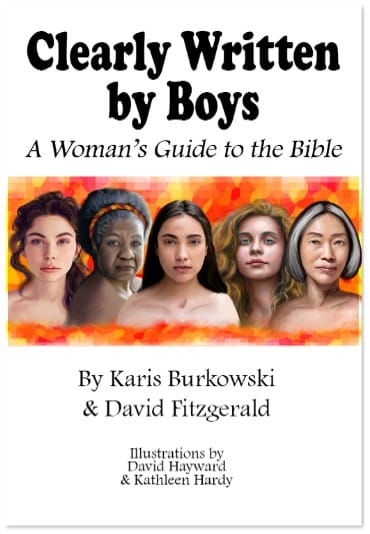
Cleary Written by Boys: A Woman’s Guide to the Bible – cover
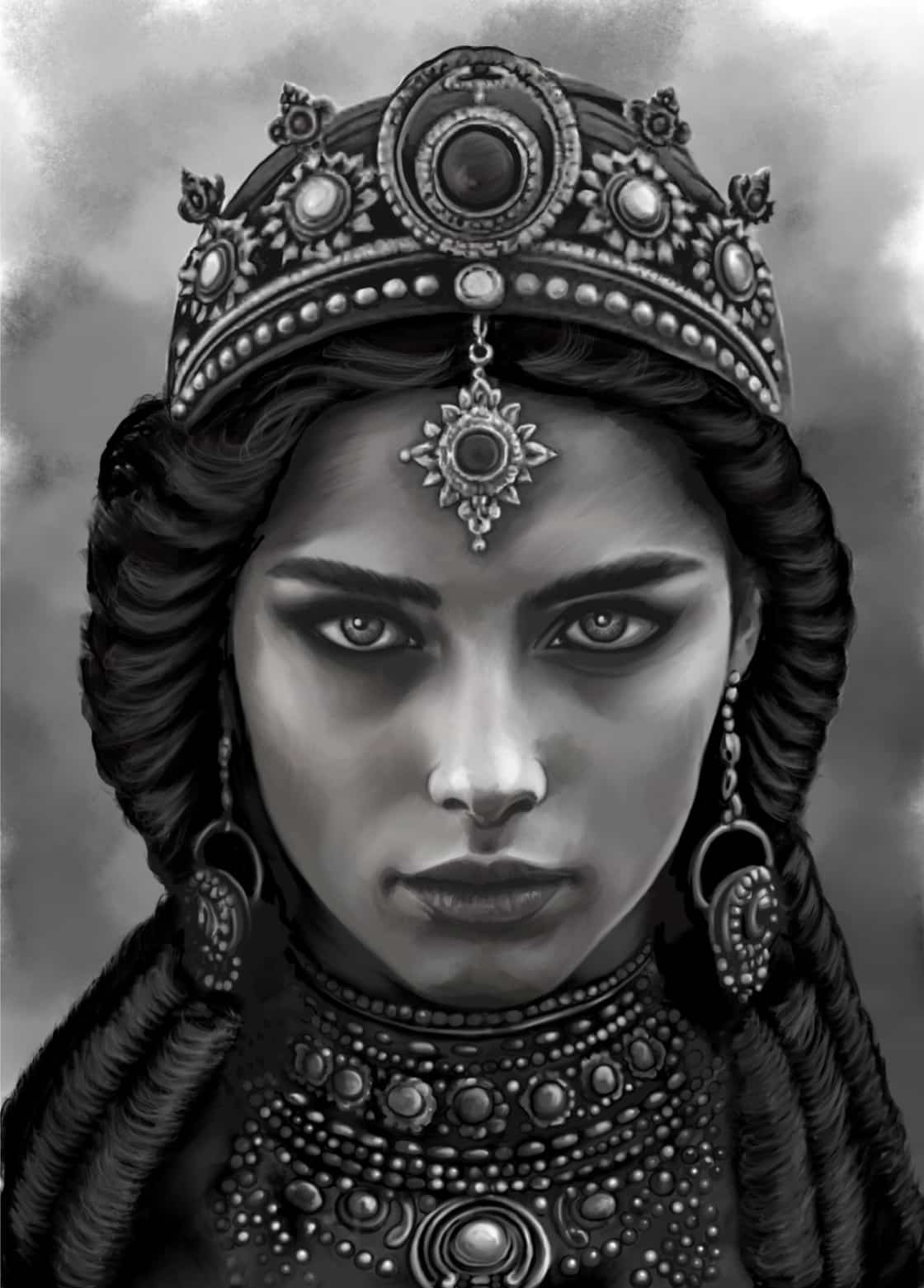
above: The striking gaze of Queen Jezebel, by Kathleen Hardy; one of several portraits of some of the most loved—and most hated—biblical women in Clearly Written By Boys: A Woman’s Guide to the Bible
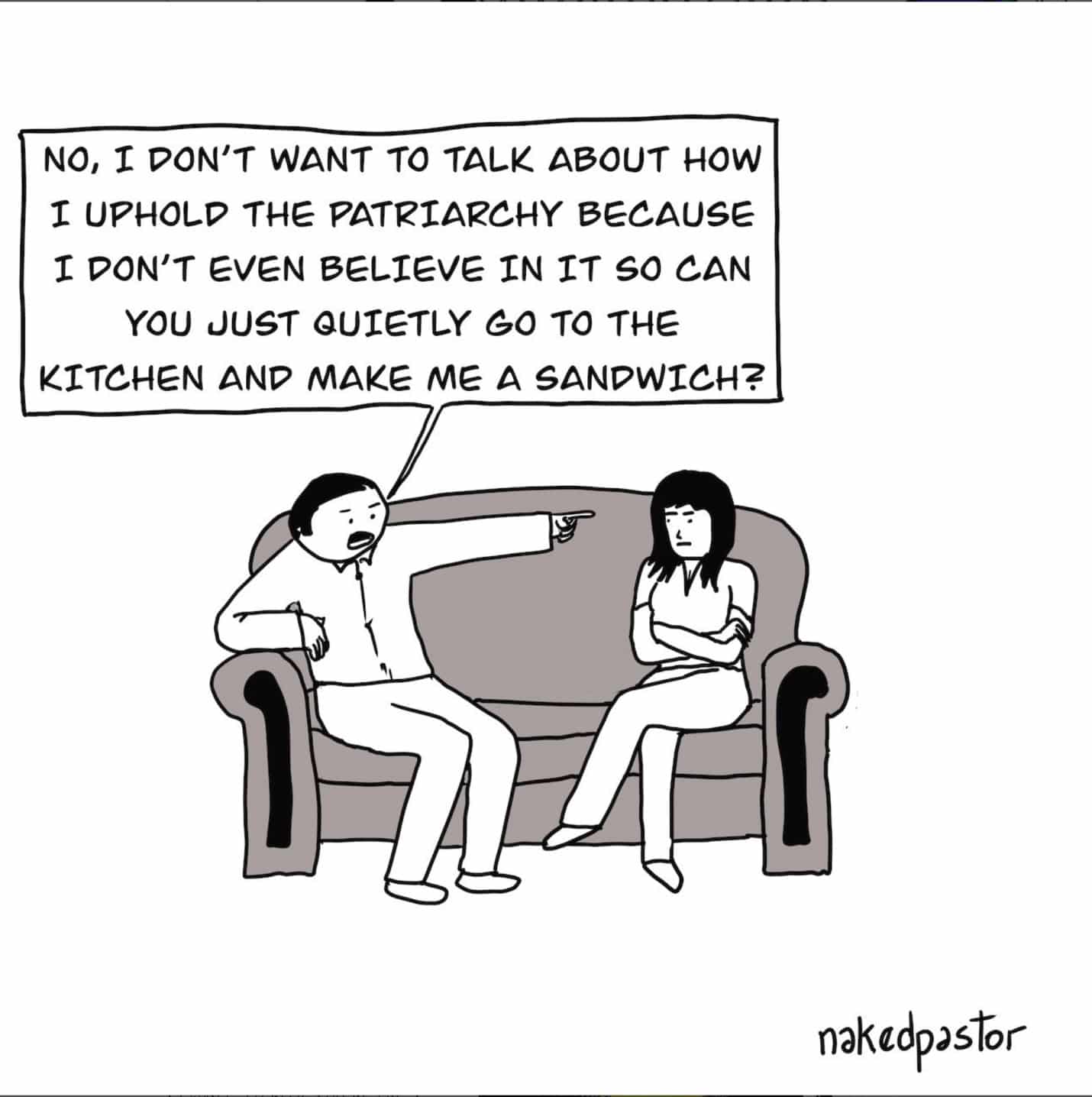
A few of the 65 cartoons by NakedPastor cartoonist (and former minister) David Hayward included in Clearly Written By Boys: A Woman’s Guide to the Bible,
- Source: Robert Rouse, viz.bible.[↩]
- Namely, Episcopal priest Lindsay Hardin Freeman’s 2014 book Bible Women: All Their Words and Why They Matter, the culmination of four years of work by Freeman and her research team.[↩]
- BAHACon (http://www.bahacon.com) is the annual summer Canadian humanist event in Sarnia, Ontario; just across the US/Canadian border from Port Huron. BAHA (not to be confused with Baja) stands for the Bluewater Atheists, Humanists, and Agnostics (the Sarnia/Point Edward area is referred to as Bluewater Country).[↩]
- Except Adam and Eve, of course—but then again, what other choice did they have?[↩]
- Though Evangelical-affiliated, Barna’s findings tend to be refreshingly scrupulous and uncompromising—even when pointing out bad news for the Christian community. As one Evangelical author commented in 2009, “I’m not saying their research is wrong. It appears to be appallingly right.”[↩]
- Copeland and Kinnamen, Is Church Attendance Turning Upward? And a Surprising Gender Gap, Barna, Church September 3, 2025. https://www.barna.com/research/unexpected-gender-gap/[↩]
- At the end of the book there is a special section on questions and discussion topics for book clubs, classes and other groups.[↩]