

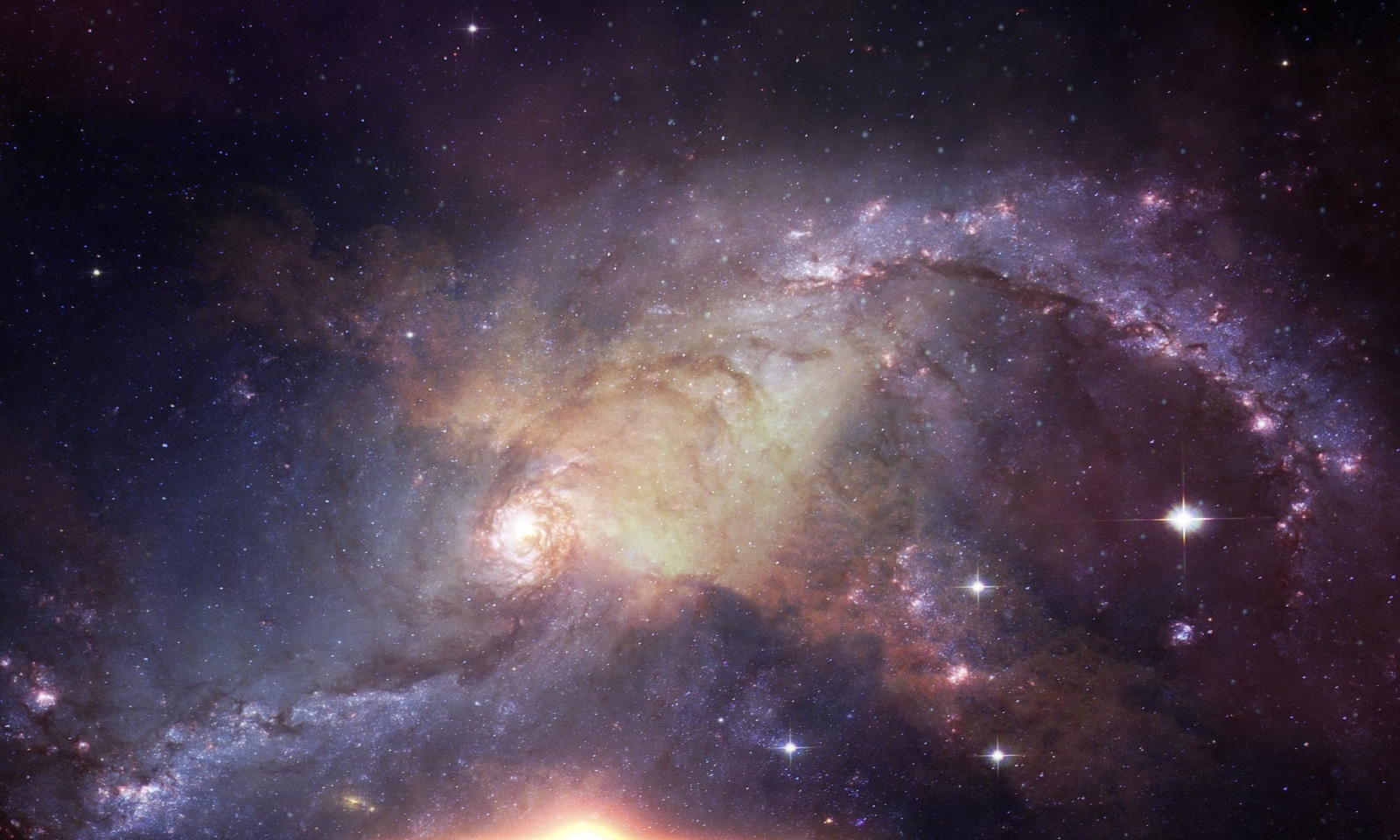
Human beings have evolved to be able to enjoy a wonderful, sensuous existence, with wonderful sights, tastes, sounds, smells and touches.


It is easy to feel a sense of hopelessness living as we do on a tiny planet within the vastness of a Cosmos that at first glance has no concern for human beings or their future. But Humanism itself takes its name from the belief that there is something very important about human beings that should be protected, encouraged, and developed toward its highest possible fullness. We repudiate forms of escapism.
One of the reasons why humanism is skeptical of classical religious dogmas is that they can easily represent a form of escapism. D.H. Lawrence, in his famous little book Apocalypse, castigated Christianity for postponing the fullness of life into another world with God after death. On the contrary, he proclaimed, “We should dance for joy that we are alive and in the flesh once and once only.” But experiencing the joy and fullness of life is not the end of the matter, for human beings cannot live without hope.
Human beings have evolved to be able to enjoy a wonderful sensuous existence, with wonderful sights, tastes, sounds, smells and touches. Yet the Hedonists of the ancient Greek world already knew that there must be restraint and refinement of these sensuous capacities in order to maximize the pleasure of life within a world framework that appeared hopeless, dangerous, and irrational. The world system today, that threatens us with nuclear holocaust and that appears incapable of protecting or restoring our collapsing planetary environment, does not appear any better than that which confronted the ancient Hedonists. The situation appears to encourage an attitude of “Eat, drink, and be merry, for tomorrow we die.”
Yet like the postponement of the fullness of life to another existence after death, and like the hedonistic sensuous indulgence within a world that appeared irrational and chaotic, many of us find that a very real dimension of the fullness of life requires hope. The gift of human action, temporalized as it is between past and future, appears to link a meaningful life of action to expectation of success, or at least that we may contribute to larger enterprises that are moving toward success within a more distant future.
Humanists generally affirm science. But the view of scientists has been slowly changing since the early 20th century, and today remains somewhat divided. The early modern discovery of the scientific method by such thinkers as Descartes, Galileo, and Francis Bacon ultimately led to a gigantic synthesis in the work of Sir Isaac Newton whose book Principia Mathematica appeared in 1687. From the work of Newton, a pervasive “scientism” developed that saw the world as atomistic, mechanistic, and deterministic. The remnants of this view remain with us to this day.
The apparent freedom that human beings feel when they make choices and pursue purposes was thought to be an illusion by many who embraced early modern scientism. The universe appeared as a giant machine that operated according to the laws of physics and chemistry whose deterministic interactions could be mathematically calculated and verified in repeatable experiments yielding the same results. Those who continued to believe in the God of Christianity, Judaism, or Islam clung to what appeared to be an untenable dualism. They held that the deterministic body (made of matter and obeying the laws of physics and chemistry) was animated by a soul that came from God. It was this dualistic soul that gave us freedom that matter itself did not possess. Descartes himself believed in a version of this dualism between mind and matter that had a powerful influence in the 18th and 19th centuries.
The question of the unity (vs. dualism) of mind and body remains at issue today, with some stances more dualistic to account for human freedom and some stances reducing the mind to the body (physicalism) at which point freedom again appears as somewhat illusory in the face of the apparent determinism of natural laws. Neither appears satisfactory, and neither appears as a ground for genuine hope within this life and on this planet. Today, we experience a third option—that the universe itself is creative and that human freedom is a consequence of this creative evolutionary upsurge.
In this essay, I maintain that there were at least two immense discoveries that have moved contemporary thought decisively away from Cartesian dualism as well as scientific naturalism. The first came with Immanuel Kant’s Critique of Pure Reason, published in 1781. The second came with the publication of Charles Darwin’s On the Origin of Species in 1859. Some 20th century thinkers (like Jan Smuts, 1926, Teilhard de Chardin, 1959, or Errol E. Harris, 1988) have combined these discoveries in a new humanism that appears to restore a meaning and purpose to life not even dreamt of by the 17th century founders of modern science.
Kant’s Critique of Pure Reason uncovered the immense role played by the human mind in the apprehension of the world. It is not just that we look at things (using our five senses, as empiricism often held) and then with the use of careful reasoning we discern how things are and the ways in which they work. We do this, of course, but Kant understood the immense role that the mind and it’s a priori structures plays in constructing the “objective” world that we experience all around us. The extent to which the mind operates in the construction of our experience has been hotly debated since that time.
Yet with regard to the question of mind and body, Kant made one thing very clear. The very possibility of gaining knowledge of the world, and of experiencing the world as one world came from what he called “the Transcendental Unity of Apperception,” or the Transcendental Ego. The human sense of self involves as a unity that persists throughout our lives. I am the same person (in some fundamental sense) as I was 20 years ago or 40 years ago. I am able to gain and synthesize knowledge and understanding only because my memory is informed by this transcendent unity. If I were totally immersed in the temporal flow, there could be no memory, no learning, and no anticipations of the future.
This transcendental unity persists through time even though our bodies, along with our mental thoughts, images, and experiences, are constantly changing. Indeed, in the 5th Century BCE, Plato, in his Phaedo, had made this sense of an enduring selfhood the basis for his argument for the immortality of the soul. Kant is not here positing a soul, but rather an a priori feature of our consciousness that makes knowledge and our experience of the unity of the world possible. Kant showed that this transcendental unity is a necessary condition for there being any knowledge whatsoever, and this is also a necessary condition for our experience of one world toward which all our knowledge is directed. In other words, there is a principle in us that in some sense transcends space and time and that makes all knowledge and experience of one world possible.
The other major insight came with the empirical confirmation of the Cosmic evolutionary process that began with Darwin’s 1859 publication. Exactly one century ago, Jan Christian Smuts, in Holism and Evolution, declared that, “Darwin has changed our whole human orientation of knowledge and belief…and has probably made a greater difference for human thought and action than any other single thinker…. He has pointed the great way, and on that way we are already travelling beyond his great vision” (1986, 185-86). Darwin gave us the first provable and powerful understanding that our universe is not static but rather in motion: evolving—going somewhere.
The Cosmos is not a Newtonian machine created a few thousand years ago (as the Bible appeared to claim) and then left to run on its own mechanistically and deterministically. Darwin unveiled the vast scale of biological evolution, a scale that was super-enlarged by Einstein’s theory of general relativity in 1915 and exploded cosmically in E.P. Hubble’s discovery in 1929 that the universe was rapidly expanding from from its origin as a primeval explosion of unimaginable proportions. The entire universe has been evolving for the past 13.8 billion years and biological evolution of life on Earth is a fairly recent development of that cosmic evolution (perhaps the past 3.8 billion years).
We can now begin to see the significance of Kant’s Transcendental Unity of Apperception. The Cosmos has evolved a creature that has become self-aware and whose activity can progressively comprehend the entire structure and movement of the Cosmos. Not only this, the Cosmos manifests “emergent evolution” (since it appears to be going somewhere), and the emergence of a creature who can comprehend this telos or direction appears as a consequence of this Cosmic aspiration. It looks as though the Cosmic nisus (purpose or direction) involves human beings.
As Indian thinker Sri Aurobindo put this, “the Universe….creates a self-conscious concentration of the All through which it can aspire” (1970, 45). As Teilhard de Chardin expressed it in The Phenomenon of Man, “Man discovers that he is nothing else than evolution become conscious of itself” (1959, 221). As philosopher Errol E. Harris observed in The Reality of Time, “Thus, our consciousness of ourselves is at the same time the consciousness of the world and the world’s consciousness of itself” (1988, 104).
The entire conceptual framework of science is being transformed. Scientists now link the rise of human life with the trajectory of the evolving Cosmos (calling this “the Anthropic Principle”). Human beings do not now appear as a cosmic accident, as an animal that just happened to become conscious of itself (as Friedrich Nietzsche declared). We now appear as a “leading shoot” of the telos that animates the Cosmic process. The Cosmos has become conscious of itself in us. What implications might we derive from these insights?
If humanism focuses on human beings, rather than some imaginary “other world,” and if humanists cling to science and rationality and wish to focus on these to improve the quality and conditions of human life, then here we have a set of (r)evolutionary concepts that can vastly empower our action and our lives. The universe has been found to manifest telos (rather than randomness), and it has produced a creature characterized by a unique feature (self-awareness through the transcendental unity of its mind) that allows us to discern the process and its direction, and that allows our lives to be future-oriented as well as morally responsible. What is that direction?
Teilhard de Chardin (a Christian scientist) called it “Omega,” a divinely inspired unification and fulfillment of conflicting elements. Jan Smuts, a much more secular thinker not identified with any religion, called it “holism”—the Cosmos is evolving ever greater wholes, ever higher levels of integration and oneness. For Smuts, the great breakthroughs of evolution were the beginning of life, then ever higher manifestations of conscious life, and finally (with human beings), the manifestation of self-aware life capable of discerning the entire process and of contributing to its upsurge. This process revealed that our human purposes should also be emergent holism.
With human life evolution has reached another emergent breakthrough: freedom. “Evolution,” Smuts writes, “on this view is really creative and not merely explicative of what has gone before…. It releases the present and the future from the bondage of the past, and makes freedom an inherent character of the universe” (1986, 85). Freedom is a cosmic phenomenon, and has a cosmic purpose. The upsurge toward ever great holism has now been placed in human hands.
Kant and his successors had distinguished between the “empirical ego” and the transcendental unity of the self. The two are not to be confused. When we live from the Transcendental Self that makes freedom and unity possible (rather than egoistic goals and desires), then we are living from the authentic “personality.” “Personality,” Smuts declares, which is the highest, most evolved whole among the structures of the universe,…becomes a new… originative center of reality” (1986, 86). Thus, he concludes that, “the individual Self or Personality rests not in its individual foundations but on the whole universe” (245). Smuts understood the significance of the Transcendental Unity of Apperception that is the voice of the evolving Cosmos in us.
Personality itself generates higher holistic values, which Smuts terms “Holistic Ideals, or Absolute Values”—“Such are the Ideals of Truth, Beauty, and Goodness, which lay the foundations of a new order in the universe” (1986, 107). The more we live from the transcendental personality in ourselves the more hope emerges, direction emerges, and transformative freedom emerges. Human beings and their purposes take on a quality larger than contingent social arrangements or historical constructs. We orient our lives and our thoughts to the larger goal of establishing a kingdom of true unity in diversity for our endangered planet Earth.
It is well known that Jan Smuts was a prominent South African politician who had a hand in creating the League of Nations after the First World War and also helped write the Charter of the United Nations after the Second World War. In his 1926 book that we are here considering, he writes, “the League of Nations, the chief constructive outcome of the Great War, is but the expression of the deeply-felt aspiration toward a more stable holistic human society” (1986, 344). The League was a step toward planetary holism but, as we all know, failed to sufficiently unite the world, thereby making possible a second World War. After World War II, Smuts again attempted to move the world toward holism by helping draft the UN Charter.
Today, a century after the publication of Smuts’ book, and 80 years after the founding of the UN, we cannot but recognize the failure of the UN Charter to unite the world under a principle of unity in diversity. The Charter is based on the absolute sovereignty of some 194 territorial entities, each with the right to militarize itself to the teeth and each competing for resources, trade preferences, power ascendency, and “security.” The world is a mess, and its fragmentation (in violation of our emergent evolutionary telos) represents a major cause of our failure to progress to a lawful planetary civilization premised in unity in diversity, genuine peace, reasonable economic equality, and concerted environmental actions to protect and restore our planetary ecosystem.
The Constitution for the Federation of Earth provides the template for the ascent to planetary holism. Smuts maintained that human “purposes” were a channel through which the Cosmic holistic telos could flow into human affairs. The Preamble to the Earth Constitution focuses on the unity in diversity of planetary civilization, and Article 1 frames six purposes for the Earth Federation government. First, establish lawful peace and disarmament, second, protect universal human rights, third, strive for planetary social equity, fourth, regulate and coordinate planetary processes, fifth, protect and restore the planetary environment, and sixth, deal with all other global issues that are beyond the scope of nation-states.
The Cosmos has evolved a finite creature with a transcendental unity of consciousness, in the words of Sri Aurobindo, “through which it can aspire.” The emergent (r)evolutionary holism of the Cosmos can only continue to act through us if we transcend the fragmented and divisive institutions that make a world a place of wars and chaos. We do not abolish the nations but unite them under the principle of unity in diversity, so that their creative diversity can contribute to the continuing civilizational wealth and well-being of humankind. Our evolutionary humanism discerns a telos to history and a great hope.
The movement behind the effort to ratify the Earth Constitution has established a Permanent Secretariat for the Provisional World Parliament and has initiated a process that will lead to another “constituent assembly” at which the Earth Constitution will be reviewed and updated. The Cosmos drives toward ever greater levels of emergent holism, and the Earth Constitution represents the next stage in the ascent of humanity in accordance with its emergent (r)evolutionary telos. Now is the time for human beings to begin registering as voting global citizens under the Constitution as we expand the Provisional World Parliament, holding sessions every 4 months. Hope calls to us from afar—toward a future of democratic world law under the Constitution for the Federation of Earth. 