

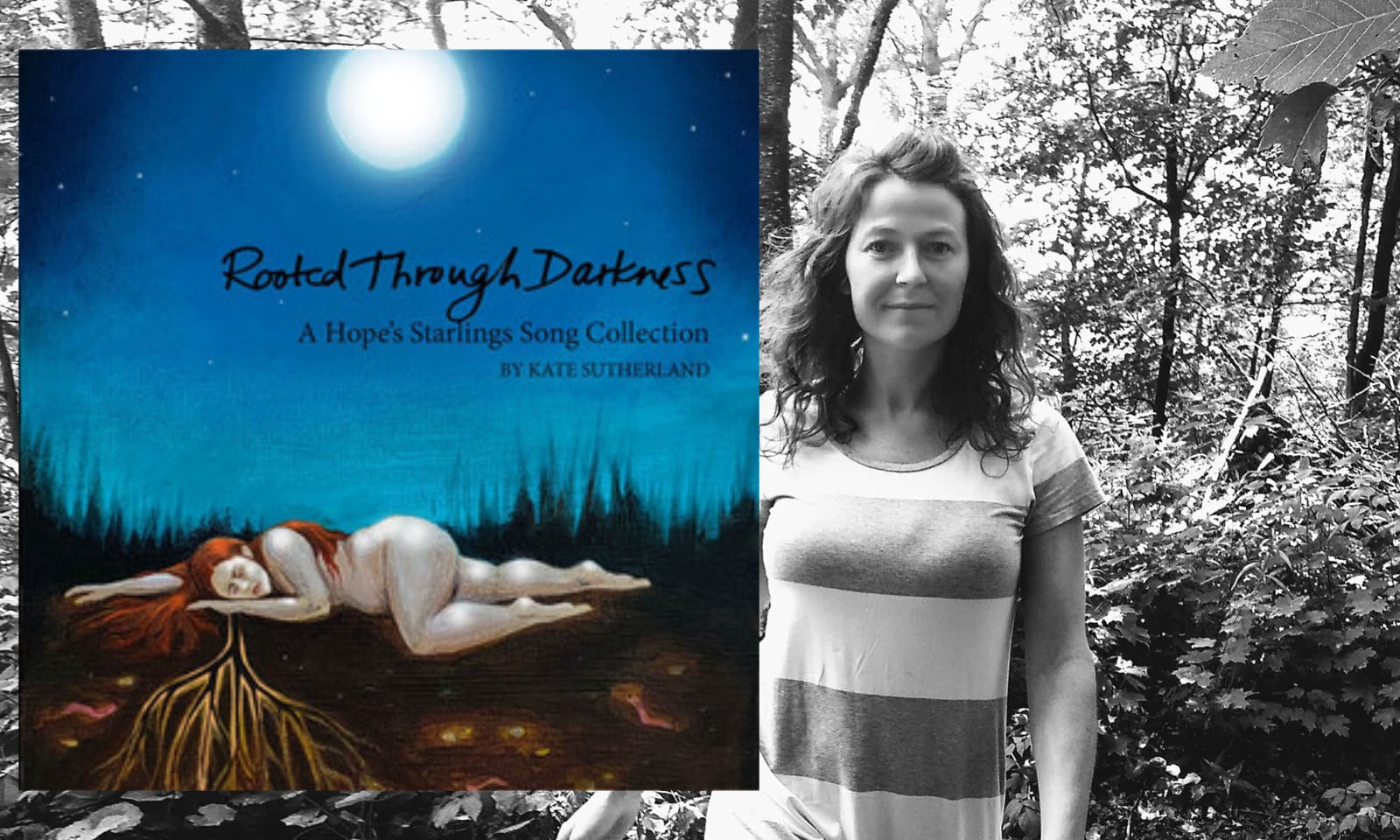
Kate Sutherland's Rooted Through Darkness is a thoughtful exploration of resilience, belonging, and the quiet forms of hope that emerge when we learn to move through darkness together.


| Rooted Through Darkness (by Kate Sutherland) Independent release 2026 12 tracks, digital/CD |
Kate Sutherland’s Rooted Through Darkness (https://katesutherland.ca/rooted-through-darkness) is a thoughtful exploration of resilience, belonging, and the quiet forms of hope that emerge when we learn to move through darkness together. The album offers listeners a musical landscape that is contemplative without becoming sentimental and hopeful without denying the realities of grief, uncertainty, and change.
Sutherland, with her singing companions, share a tonal palette that is warm and earthen. Including grounded drones, hand percussion, piano, and guitar that breathe rather than insist, with layered harmonies that move like weather fronts. Throughout the album, every musical gesture remains tethered to something rooted-deep. Even when the arrangements become richer, there is always space between the parts. Silence and resonance become collaborators, allowing each song to unfold with quiet confidence.
One of the album’s most compelling pieces, “Light in Darkness,” captures the spirit of the collection. Rather than presenting hope as optimism or easy certainty, the song suggests that light held within is strengthened through relationship, perseverance, and the willingness to remain present even in difficult times. Its gentle melody and careful arrangement invite listeners to sit with vulnerability rather than flee from it, reminding us that resilience often grows quietly in community and compassion rather than through individual triumph.
Lyrically, the album speaks in the plain language. Sutherland resists spectacle in favour of practice. Singing becomes a way of holding grief, celebrating small continuities, and reconnecting with the larger community of life. It is striking how often the solitary “I” gives way to “we,” and how consistently the more-than-human world appears not as scenery but as companion and teacher. Rivers model flow, trees embody patience, and wind offers uplift without possession. Belonging emerges not as an identity to defend but as a relationship to cultivate.
What distinguishes Rooted Through Darkness is its moral clarity without preaching. These songs work first on the nervous system, inviting listeners to slow their breathing, listen deeply, and inhabit a rhythm of time larger than personal urgency. In that embodied shift, the album’s central themes—interdependence, reciprocity, stewardship, and hope—become quietly persuasive. One comes away less impressed by technical virtuosity than by the music’s capacity to accompany everyday life. These are songs that belong in kitchens, forests, vigils, classrooms, and community gatherings. Their greatest achievement is their ability to be shared and sung.
Another standout, “Worthy,” speaks directly to a deeply human experience: the tension between self-doubt and self-acceptance. Rather than offering easy reassurance, the song gently accompanies listeners through uncertainty toward self-compassion. Its closing words—“I am worthy, even when I doubt”—are disarmingly simple yet profoundly moving. They offer a compassionate place to land for anyone who has questioned their own value and remind us that worthiness is not something to be earned but something to be recognized, even in moments of uncertainty.
Rooted Through Darkness is restorative not because it denies shadow but because it teaches us how to sing through dark seasons together. In doing so, it affirms a deeply humanist vision in which healing is relational, community extends beyond the human, and hope is sustained through shared voices rather than solitary certainty. It is a quietly radical album: humble in gesture, expansive in consequence, and beautifully attuned to the kind of future that begins in the human voice and spreads by echo. 