

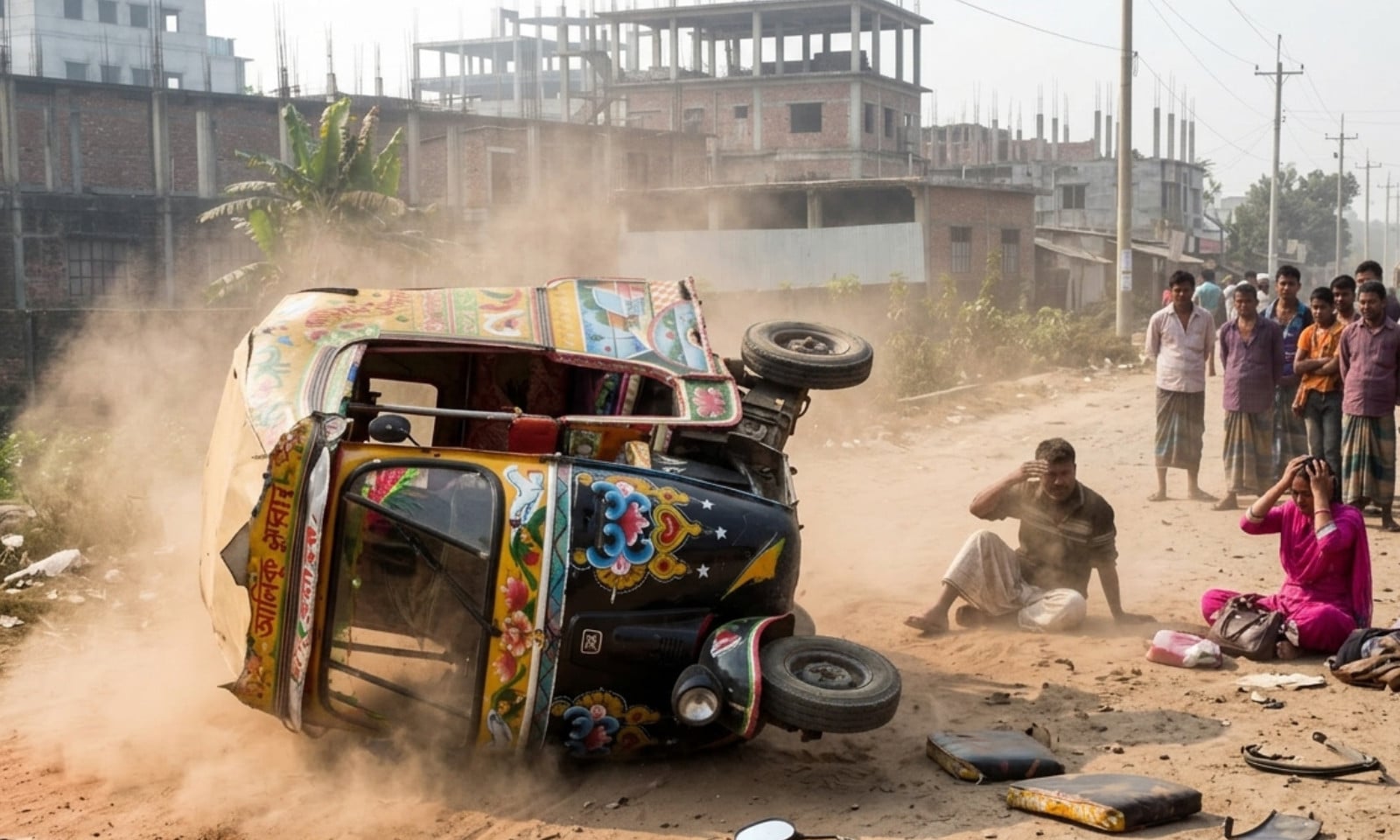
On a straight patch of road, a black van with mirrored windows suddenly passed at a very high speed, recklessly swerving back into the lane to avoid an ongoing truck.


When Michael Bedford moved to Dhaka, Bangladesh to work as US Peace Corps County Director. he expected to help both the volunteers and the Bangladeshi people get to know and learn from each other. On one ordinary day in the rural countryside, he was cast into a situation that demanded his skills as a person, as a director and as a US government employee. What he had not expected was the ethical dilemma forced upon him, whether to follow his personal values or to follow his job expectations.
In ethics, there is a clear divide between absolutism and relativism. Ethical absolutism is based in the belief that there is a singular universal moral standard across all peoples & cultures. Moral relativism, however, is the belief there is no universal or absolute set of moral principles, but rather that circumstances are culturally shaped, affecting choice. Societies make moral choices based on their unique beliefs, customs, and practices. People tend to believe that the “right” moral values are those that exist in their own culture, especially if there is no “outside experience” to challenge one’s given values. As a foreigner working in Asia, I was presented with unfamiliar, difficult ethical challenges, where my Western beliefs no longer seemed applicable.
In 2001, as the US Peace Corps Bangladesh Country Director, I went by rental car to see how a new PC volunteer was settling into his remote new home. On a straight patch of road, a black van with mirrored windows suddenly passed at a very high speed, recklessly swerving back into the lane to avoid an ongoing truck. In an instant, the van clipped the side of a baby taxi [a motorized three-wheeled auto rickshaw] traveling in front of my car. The small rickshaw spun in circles, then flipped six feet into the air and crashed onto its side. My driver slammed on the brakes and thankfully we stopped inches short from hitting the rickshaw. From the back of the vehicle, a wall of market-bound fish cascaded out, along with four people. One young boy fell out bloody, dazed and seemed seriously injured. Then an older man fell out, blood streaming down his face. The young boy stumbled off the road and collapsed. Out of the front emerged another man covered in blood. People were hurt.
My choices were based on what I could offer versus what I should do. I had a vehicle that could help take them to medical care, I had cell phones. But I did not stop to help the injured, choosing to abide by the US Embassy rule that a US government employee never stops for an accident. The rationale is after an accident, people will gather, things will be said as provocation, and the crowd can turn on the foreigners. Money often is demanded; threats made; violence possibly could escalate. The underlying anger of poverty, privilege, and powerlessness smolders until presented with an opportunity to erupt. The driver of the black van did stop, but did nothing to assist the injured. He inspected his car for any damage, then got back in and drove off. A crowd assembled but did not help.
As a fellow human on this planet, I felt compelled to help. I was faced with people in dire and extreme need; the boy needed immediate hospitalization. I had a car that could have taken the boy to a medical clinic. In retrospect, what should I have done? What could I have done? What would I hope a stranger would do for my injured son? Should I have acted as I hoped others would act?
What if I had braved the risk of being involved, picked up the boy & took him to one of the few hospitals in Bangladesh, hours away in the major city of Chittagong? And there are the financial costs to any medical treatment that the poor simply cannot afford.
If I did not immediately help, who could I call to get medical assistance? I had a rudimentary cell phone geared toward international calls and another to use in rural areas where there was limited cell service. There was no national medical service to plug into. There was no phone directory to find a hospital; no “911” to call in an emergency.
The baby taxi was destroyed. A livelihood lost. Who paid for the accident and destruction of the vehicle? Did the boy survive? The older man? I do not know. The consequences unfolded long after I left.
The dilemma of my wanting to help is based on a belief that an ethical standard applies regardless of culture, versus one that is shaped by a cultural context. Even now, I find my choice staggering, seeing a child suffering and knowing I could have done something to help. Though I had reasons for not acting, my inaction still haunts me, over twenty-five years later. I had been correct following US Government policy, but not ethically right with my inaction.
Still haunted by this dilemma 25 years later, I accept I will not again leave the immediate suffering in front of me. There are rules that need to be broken for a higher level of our common humanity. I know I would now offer assistance because it’s simply the right thing to do, emphasizing the need for ethical reasoning, empathy, and integrity. And I would do what I would hope others would do for me. Finding reaffirmation in the words of Albert Schweitzer, “The purpose of human life is to serve, and to show compassion and the will to help others.” 