
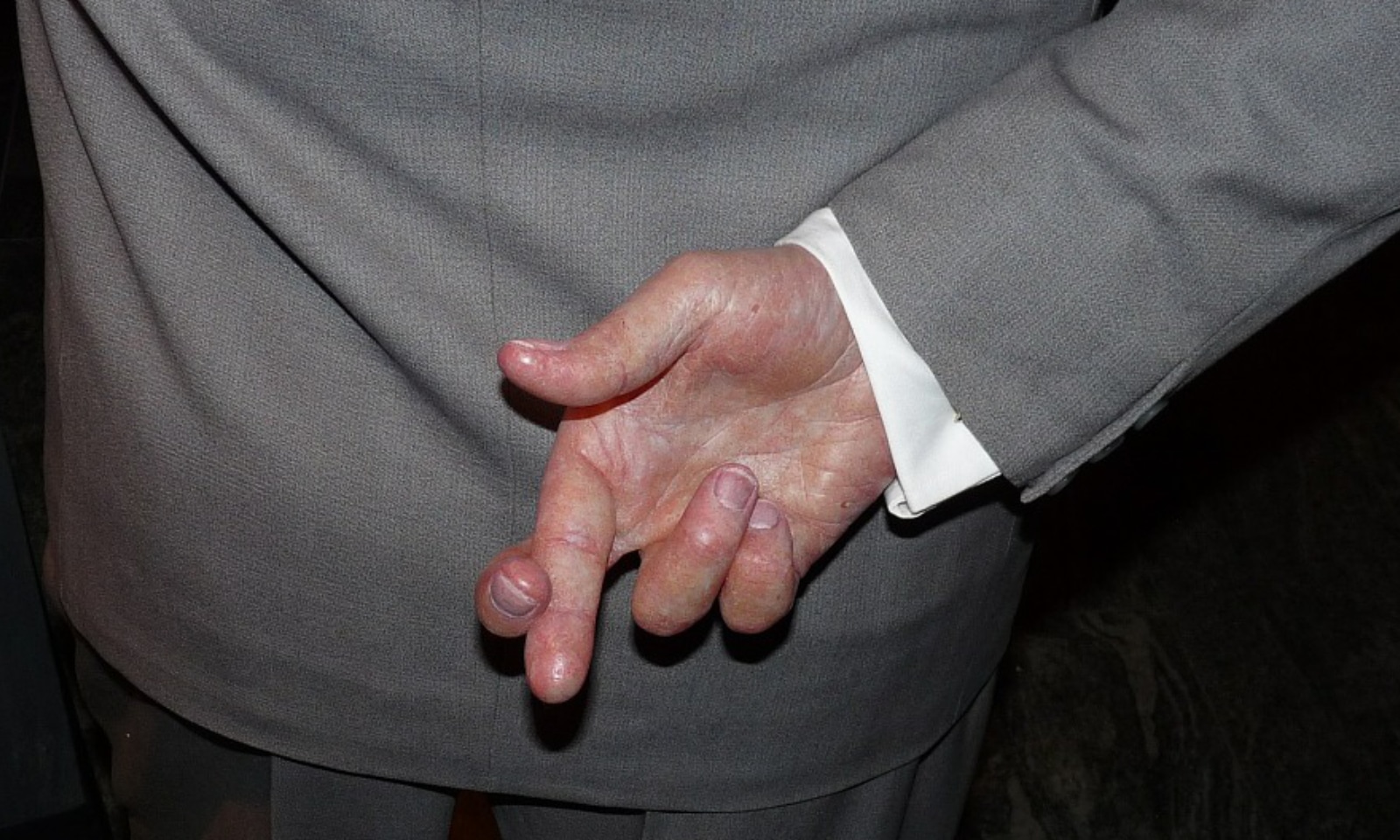
Can a democracy function as such when those who are supposed to carry out the wishes of citizens regularly lie to them on matters of clear public import?


Introduction
The essential idea behind democracy is self-government: the people are to govern themselves. It was Abraham Lincoln in his Gettysburg Address who expressed the idea in what has become its classic form: democracy is “government of the people, by the people, for the people.” In large, complex societies self-government requires the election of representatives who make, and are supposed to ensure the implementation of, decisions aimed at carrying out the will of the people who elected them.
Can a democracy function as such when those who are supposed to carry out the wishes of citizens regularly lie to them on matters of clear public import? Of course not: “For a democracy to function it is essential that a government respects the people and takes them seriously, not only those that have voted for that government, but all people.”1 Respect and seriousness are clearly key.
There is a loss of confidence in government in many jurisdictions, including many of the world’s democracies. Every egregious lie told by an elected politician, or person appointed by one, worsens this lack of trust and further weakens the democracy in which it is told. But it’s worse than that: especially where the lies are told in a country much heralded as a foundational example of democracy, such as the United States, those lies weaken the idea of democracy and further weaken all democracies.
It is then imperative that we all try to understand the essence of this lying problem.
The lying by the U.S. president, his administration and supporters is brazen and unrelenting
Donald Trump is now notorious for his lies. One of his earliest of significant public import was his claim that Barack Obama was not born in the United States and thus was not eligible to be elected to the presidency. The group think around this lie is referred to as “Birtherism.” Trump was an adamant birther for many years and was largely responsible for keeping the lie alive. In 2019 Kelley-Romano and Carew wrote:
The conspiracy, which gained traction amid the 2008 Presidential election, alleged that Barack Obama was ineligible for the Presidency on grounds he was not born in the United States. Though the movement was continuously debunked by a myriad of people, birthers remarkably managed to keep the conspiracy alive and relevant, due in large part to Donald Trump.2
In the eyes of many, the most spectacular lie that Trump continues to propagate concerns the outcome of the 2020 presidential election: Trump insists he beat Joe Biden in that election and was thus robbed of that victory. The lie is brazen as there is no evidence to support it and much evidence, including from dozens of legal proceedings across the U.S. that tested Trump’s claims of fraudulent voting for Biden, that refutes it.
Trump regularly lies about many things. When his public pronouncements are carefully fact-checked, that scrutiny nearly always reveals significant deviations from truth. The lying is unrelenting – one could say he shows a completely reckless disregard for the truth – and it is endorsed by both his supporters and many in his administration. Indeed, espousing Trump’s lies has often constituted something of a loyalty test. In 2022 – so, between Trump’s two terms as president – New York Times columnist Carlos Lozada wrote in “The Inside Joke that Became Trump’s Big Lie”:
And much as support for the 2020 election lie provides a loyalty test in the Trumpified Republican Party, a willingness to believe the worst of Obama was a near-requirement in the party during his presidency. “A testing ground for Republican squishiness was how strongly, and how bitterly, one opposed Obama,” the historian Nicole Hemmer recalls …3
The lying is so frequent, so unrelenting, many have become somewhat inured to it. It is said by some to have become “normalized.” But it cannot be normal in a democracy.
Vaclav Havel: A glaring contrast worth recalling
Vaclav Havel was a dissident playwright who became president of what is now Czechia in the aftermath of The Velvet Revolution which overturned communism in what was then Czechoslovakia. In his recent speech at Davos, Switzerland, Canadian Prime Minister Mark Carney referred to Vaclav Havel’s essay “The Power of the Powerless.” In the essay, Carney tells us, Havel “asked a simple question: How did the communist system sustain itself?”
And his answer began with a greengrocer. Every morning, this shopkeeper places a sign in his window: “Workers of the world, unite!” He doesn’t believe it. No one does. But he places the sign anyway to avoid trouble, to signal compliance, to get along. And because every shopkeeper on every street does the same, the system persists.
Not through violence alone, but through the participation of ordinary people in rituals they privately know to be false.
Havel called this “living within a lie.” The system’s power comes not from its truth but from everyone’s willingness to perform as if it were true. And its fragility comes from the same source: when even one person stops performing — when the greengrocer removes his sign — the illusion begins to crack.
In Carney’s view, “it is time for companies and countries to take their signs down.” The world order established post WW II is over and only with a clear recognition of this will a new one, that could be convivial to humane and democratic values, be established. If we don’t live in truth we will be crushed.
But for present purposes probably more directly apt to this essay is Havel’s January 1, 1990, “New Year’s Address to the Nation.”4 Here’s how it started:
For forty years you heard from my predecessors on this day different variations on the same theme: how our country was flourishing, how many million tons of steel we produced, how happy we all were, how we trusted our government, and what bright perspectives were unfolding in front of us.
The truth, he said, was that,
Our country is not flourishing. The enormous creative and spiritual potential of our nations is not being used sensibly… A state which calls itself a workers’ state humiliates and exploits workers. . . .
Havel put it to the people of his country point blank: “I assume you did not propose me for this office so that I, too, would lie to you.” [Emphasis added] No, they did not. Nor does any other group of people genuinely want their elected officials to lie to them.
The “existential” nature of the lying
As has been observed so many times before, once truth is no longer the standard, anything goes. Lozada quotes Dana Milbank – a frequent commentator on CNN – as saying, “once you’ve unhitched yourself from the truth wagon, there’s no limit to the places you can visit.”5
But how did the “truth wagon” become unhitched? Carlos Lozada again has useful things to say:
… the lie that Donald Trump won the 2020 election has grown so powerful because it is yoked to an older deception, without which it could not survive: the idea that American politics is, in essence, a joke, and that it can be treated as such without consequence.
And how is the idea that U.S. politics is a joke embodied in practice?:
When politicians publicly defend positions they privately reject, they are telling the joke. When they give up on the challenge of governing the country for the rush of triggering the enemy, they are telling the joke. …
When their off-the-record smirks signal that they don’t really mean what they just said or did, they are telling the joke.
The effect of this kind of behavior is to render political life farcical:
The big joke drains language of meaning, divorces action from responsibility and enables all manner of lies. “Getting the joke” means understanding that nothing you say need be true, that nobody expects it to be true — at least nobody in the know.
Those last words – “at least nobody in the know” – are significant: it’s the poor saps that don’t get the joke who still expect the lies to be true:
Together, the big joke and the big lie have turned the nation’s political life into a dark comedy, one staged for the benefit of aggrieved supporters who, imagining that the performance is real and acting on that belief, become its only punchline.
Analysis of what is emerging from release of the Epstein files, including huge numbers of emails to and from Epstein, provides illustrations of this hideous, “big” joke. In Ezra Klein’s interview of journalist Anand Giridharadas, the latter says of Trump associate Steve Bannon:
[He] describes the people who run the Augusta National Club to Jeffrey Epstein as “crackers.” He uses a racist term for white people, the specific demographics of white people that Steve Bannon used to get Donald Trump elected.
So in this moment, Steve Bannon, who deplores the globalists and people of high finance and this and that, is talking to financier Jeffrey Epstein, referring to white people in Georgia as crackers.
None of these people in these [elite] networks mean what they say when you hear them in public. They mean what they say when you’re not looking — and these emails are an extraordinary and rare chance to see what they really think about you, how they really move through the world, what their actual ends and projects are.6
As Lozada puts it: “Without the big joke, the big lie would not merit its adjective. Its challenge to democracy would be ephemeral [perhaps disappearing when Trump does], not existential.” But in jettisoning the obligation to take the job of governing seriously, existential it is.
The lying constitutes a profound disrespect of citizens
It has to be acknowledged that democracy casts heavy responsibilities on those elected to political office. It is their job to represent others to the best of their ability. The onus can be complicated to fulfill, especially when the core values of elected representatives conflict with the wishes of many they are to serve, for example, on an issue such as access to medically-safe abortion. But one thing is certain: to lie to voters is to show them utter disrespect and thus poison the democratic well.
Lying to voters is disrespectful for at least two reasons. First, as citizens of a democracy they are entitled to – they are owed – the honest service of their representatives. Only through honest interactions can democracy work as it should. To fail on this score is to show that the welfare of one’s constituents doesn’t much matter. And this is profoundly disrespectful.
Second, only very privileged people could be indifferent to the practicalities of life that are the subject of the work done by political representatives. To return to “the joke” that some say much of American political life has become under Trump, it cannot be a joke to those who depend upon government payments to survive economically, to those who serve in the armed forces and put their lives at risk for their country, to those whose health depends upon life-saving government programs. These are laughing matters only for the very privileged, the very rich. To fail to take governing seriously is to profoundly disrespect those many, many people for whom government actions, and inactions, are serious matters. The disrespect is abusively patronizing. Marie Antoinette was hardly more abusive – with her infamous “let them eat cake” – than are some of the liars currently serving in some U.S. government positions.
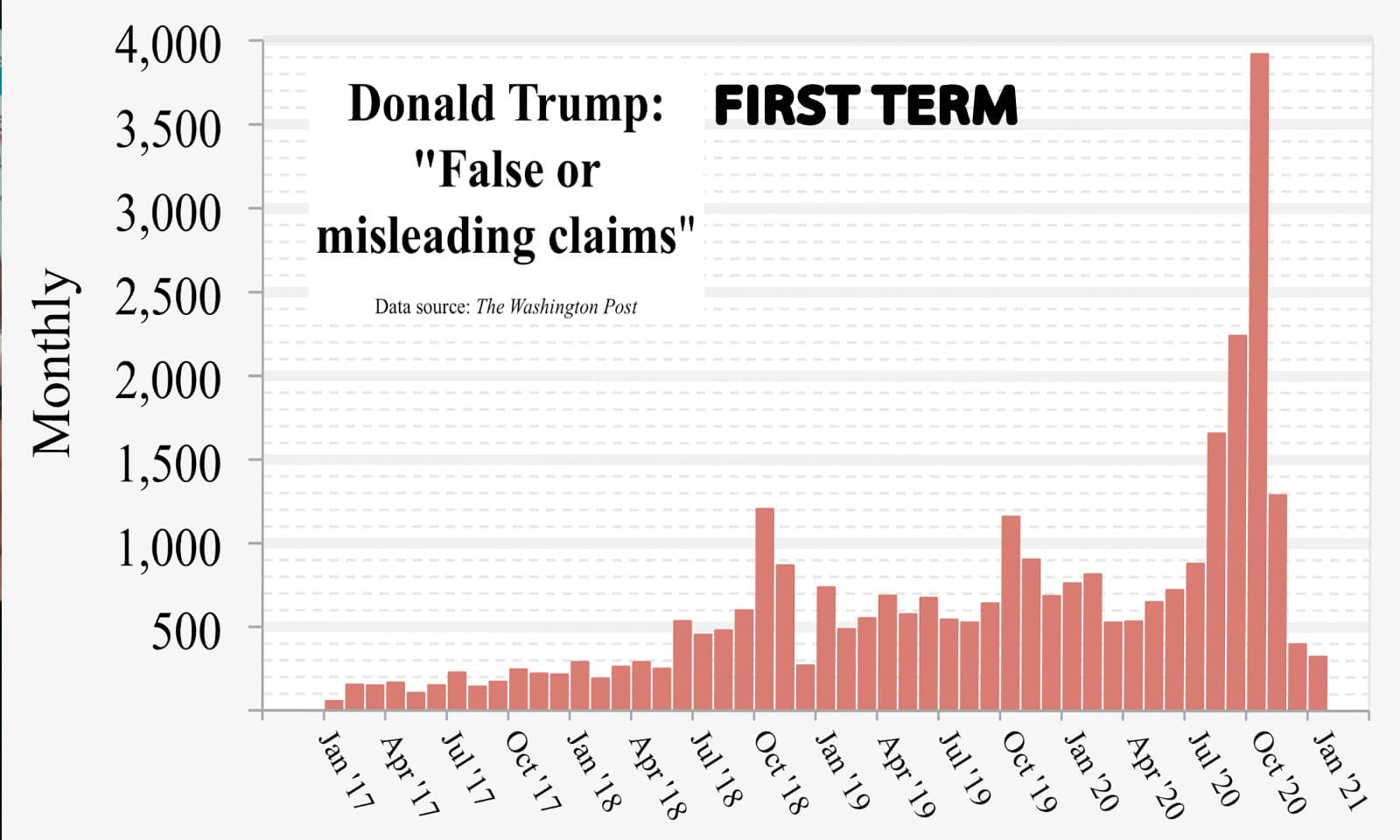
False and Misleading Claims by Trump in first term
The lying may already have gone too far
One possible comfort is that the lying may get so bad that it erodes voter support for at least the worst of the liars. There is some evidence this is already happening.
Economist Robert Reich served in a number of American federal administrations, including as Secretary of Labor in Bill Clinton’s presidency. In a recent article in The Guardian, Reich relates a conversation with a voter in New Hampshire.7
On Monday morning, I was at a restaurant counter finishing my breakfast when a middle-aged man sat down next to me … He wanted me to know that although he’d been a lifelong Republican, the events of the past weeks had caused him to leave the Republican party.
“I’m happy to hear that,” I said with a smile, and turned to finish my breakfast.
“I’m from New Hampshire and many of my Republican friends are leaving the party, too,” he said. “Minneapolis was the last straw.”
I put down my fork and turned toward him again. “I assume you’re talking about the behavior of ICE and border patrol agents there, and the killings?”
“All terrible, of course,” he said, shaking his head. “But what really finished me were the lies – Noem. Miller, Bovino, Vance, Trump.” He frowned. “They lied through their teeth. I saw the videos! Can’t trust them ever again. None of them. Pack of liars.”
I agreed and then excused myself, explaining I had to finish my breakfast and get to an appointment.
But his words stuck with me.
Reich notes that the U.S. may be simultaneously on the cusp of two precipices. One would see the U.S. turning into a full-blown police state with all the abuse of power that is built into that concept. The other is more hopeful: that at least parts of America are seeing citizens find a sense of community they may never have experienced before. This trend is being seen most clearly in Minneapolis where the brutality of ICE agents has been both lethal and well-documented.
Reich concludes his piece with thoughts on what might come next:
I don’t buy the predictions of a second civil war. I think Americans are better than that. If polls are to be believed, most oppose the way Trump has been implementing his immigration policies. Most don’t accept his fascist police state.
America may be tipping into that police state, nonetheless.
But we’re also tipping into unity against it. We’re moving into a solidarity that could give new meaning to the ideal of self-government – a system of, by, and for the people. [Emphasis added]
I’d like to believe the second tipping point will outlast the first.
Reich is not ready to accept that American politics has become a complete joke.
Conclusion
A country cannot support a democracy if its voters think they are routinely being lied to. The government they elect cannot be “their” government, if they are not generally told the truth, if they cannot generally trust government officials – elected and not – to tell them the truth. The more outrageous the lies, the more obvious the disrespect shown the voters and the more destructive of their democracy. 
- https://www.clingendael.org/publication/government-people-people-people[↩]
- Stephanie Kelley-Romano and Kathryn L. Carew “Make America Hate Again: Donald Trump and the Birther Conspiracy,” Journal of Hate Studies, February 27, 2019, p. 3: https://repository.gonzaga.edu/cgi/viewcontent.cgi?article=1138&context=jhs[↩]
- Carlos Lozada “The Inside Joke that Became Trump’s Big Lie,” The New York Times, September 22, 2022.[↩]
- See https://1989.rrchnm.org/items/show/111.html for the text of the speech[↩]
- Seeing more clearly into the future than many did at the time, Lozada continued: “You can use exaggerated warnings of voter fraud to justify state-level initiatives tightening ballot access.”[↩]
- https://www.nytimes.com/2026/02/13/opinion/ezra-klein-podcast-anand-giridharadas.html[↩]
- America has reached a tipping point on fascism – and on opposition to it | Robert Reich | The Guardian[↩]