

Stoicism is an ancient philosophy that enjoys extraordinary popularity today. It is estimated to have millions of followers.


Stoicism is an ancient philosophy that enjoys extraordinary popularity today. It is estimated to have millions of followers. Numerous books and much material on the Internet explain and advocate versions of this philosophy, a practical philosophy of life noted especially for its advice on the management of emotions.
A book group of which I am a long-term member considered a recent work by Donal Robert on Marcus Aurelius. Based on reviews and some knowledge of the author, I had suggested that we read this book. As the only group member with a background in philosophy, I was asked many questions about Stoicism during our discussions of this work. A main one was why the philosophy was so much discussed and so popular today. What is the explanation? I had to confess that I didn’t know, but I speculated that similarities between our chaotic world and the tumult and uncertainties of Rome in the first several centuries of the common era offered part of the explanation. Another factor is likely the similarity between the Stoic approach to emotion and that of contemporary cognitive behavioral therapy. Both accounts emphasize the dependence of emotion on belief.
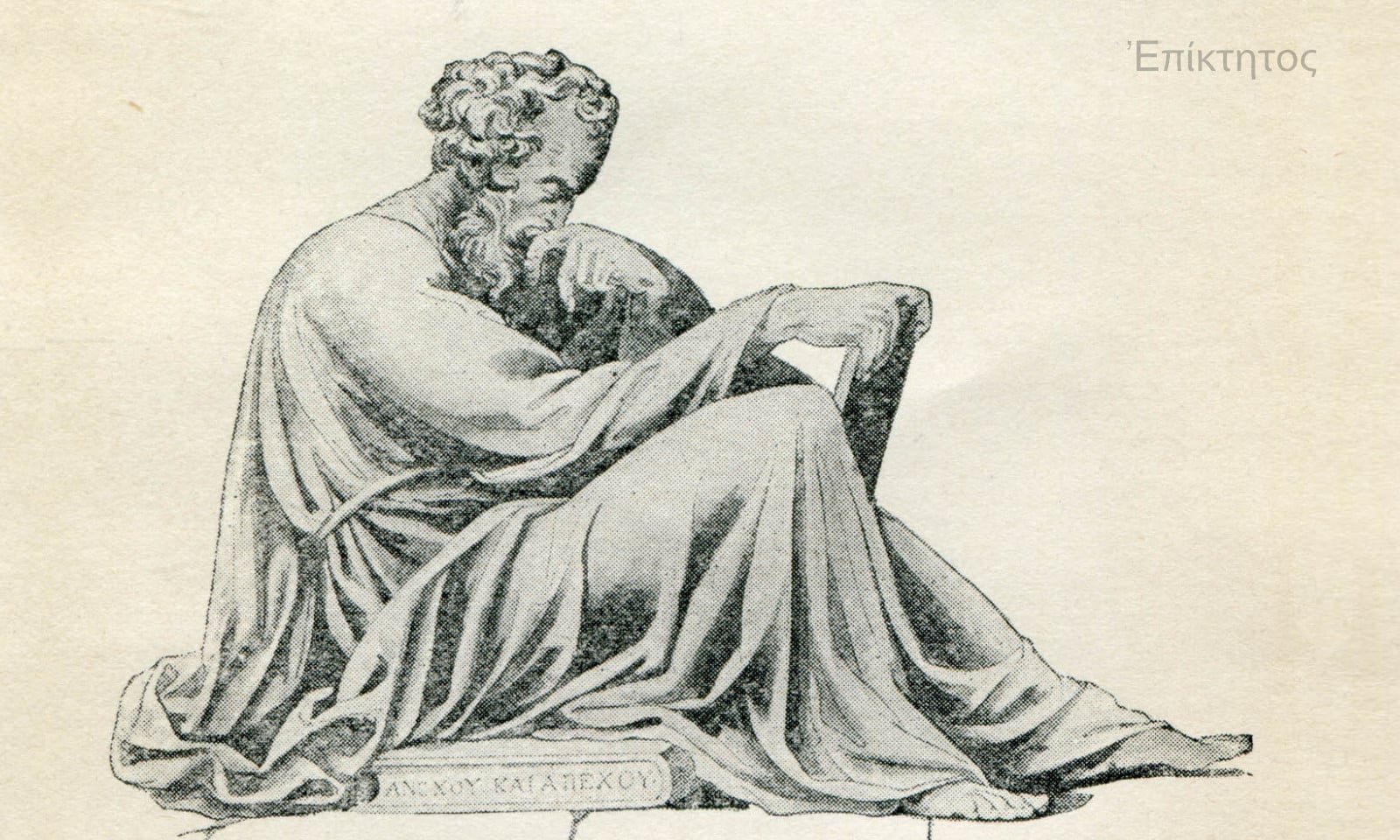
These concerns led me to study again the Discourses of Epictetus, my personal favourite Stoic philosopher. I was drawn by its practical advice, usually accompanied by admonitions to students. It turned out that my memory of the work was rather poor; I was surprised by its metaphysics which I had (conveniently?) largely forgotten.
In the Stoicism of Epictetus there is a god, Zeus. Rational, Zeus is within Nature, in everything, and present in human beings as a rational divine element. We are children of god; though the body is something we have in common with animals, the reason and mind are shared with god. The world system is deterministic: everything happens for a reason, in the sense of being fully caused. All is interdependent. Reason, unlike other faculties, is superior: it can take account of itself. In an interconnected world ordered by reason, things happen as they must and as they should; events cannot be altered.
The universe is governed by a rational and benevolent force that directs events. We may wish that some event had not occurred, but if we do so we are making a mistake. Complaining is unreasonable. What happens has to happen; for it to not happen, the whole interconnected world would have to be different, and that makes no sense. Given what has been, what is and what will be, must be. Fate is not blind and not random; the universe is ordered and not without purpose. There is no point in being frustrated, angry, or resentful regarding what happens in the world. We cannot control external events and there is no point in labelling them as ‘bad’ because they are not to our liking. There is no point in agonizing over what we cannot control. The distinction between what we can control and what we cannot control is fundamental to this system.
The god Zeus, to whom Epictetus repeatedly refers, is not external to the world, but within it. God is in everything in this system, as in Pantheism. Epictetus believed in Providence, the providence of a creator god who made the world to be a place of reason. Everything happens for a reason, which is for the best. (Here we find, surprisingly, a version of the ‘best of all possible worlds’ theory later put forward by Leibniz and satirized by Voltaire.)
From this metaphysics of determinism and Providence there emerges advice about coping and tranquillity. We must accept what is. Negative emotions are based on the metaphysical error of failing to understand how things work in the rationally order world; these things are out of our control. It is not accurate to understand Stoicism as requiring the stifling of emotions; overcoming negative feelings and attitudes is not a matter of repressing them; but of changing them as a result of effortful reflection. Rather than repression, Stoicism requires reflection, examination, and coming to understand that there is a necessary order in events. Our impressions can tell us what is happening in the external world, but it is we who superimpose value judgments on them and may come to regard what happens as bad. Informed reflections resulting from philosophical thought, and effort will lead to the replacement of ill-founded feelings by acceptance of what is and must be.
Ancient Stoicism was a philosophy of life, a system that told what was of value, what was a good or virtuous character, and how people could work toward that. Ancient Stoics maintained that the only thing in our power is the right use of appearances. To be bound to externals that we cannot control is to make a fundamental metaphysical error and to be dependent on them and dragged down by them. In the Discourses Epictetus tells his students they are sons of Zeus (reason) and, as rational, better than their ‘bit of flesh’. They should work to avoid dependence on anything out of their control; that is the way to achieve happiness.
The only thing of value is a good character (virtue), and to achieve that, we must work to develop freedom from dependence on external things. For a person to have wealth, attainments, friends, and good look said nothing about that person’s character (virtue), which is the only thing that counts. Ancient Stoicism was not self-centered. Social roles such as parent, spouse, and child were said to give related social obligations. And Stoics were citizens of the world rather than any specific city or state.
If we care about wealth, we are dependent on externals out of our control that determine whether we have it and how much. The same can be said of reputation, property, relationships, and health. If we allow our happiness to depend on such things we are “wretches” or “slaves” to elements outside our power. To be free, a person needs to have all things desired in his control. Again, we see the fundamental importance of the dichotomy of control. Externals are out of our control; the only things within our control are our assents and we should accordingly limit our desires to them. “Assents” here refers to judgments, attitudes, and feelings. To be free we need to overcome our valuing of such externals. If something we deem ‘bad’ does not affect our character, it is nothing to us and should not undermine our tranquillity. To let it do so is to be a ‘wretch or ‘slave,’ dependent on what we cannot control.
Misfortunes are opportunities to become more virtuous. What we commonly presume to be misfortunes –loss of power, wealth, home, health, reputation, even the death of a child– are external and indifferent. By understanding this we can preserve our character and tranquillity. Epictetus embraced a Socratic ethic, according to which we are not harmed if we are victims of injustice. As victims of wrongdoing we would not be harmed because that victimization does not harm our character. It is the perpetrator of wrongdoing who is harmed, because of the damage to his character.
The implications of this ethic are challenging, to put it mildly. On this account, a temperamental and egotistical dictator is harmed by his own self-indulgent and cruel actions and directives. Persons beaten, detained, or deported at his command not harmed, provided they understand correctly that what has happened was not up to them and respond appropriately to their circumstances.
Ancient Stoicism was a philosophy of life, a philosophy telling people how to live and giving reasons why. A major reason was that forming one’s judgments as advised would provide tranquillity and freedom from dependence on external factors outside one’s control. Other foundational reasons were metaphysical: god, determinism, pantheism, and Providence. Fundamental was the dichotomy of control. For things out of our control we should not concern ourselves; for things in our control, we should assent and choose according to virtue. Distinguish between what is within control (assents, what you will) and what is not. Learn that only the former affect character (virtue) and restrict concerns to that. In the philosophic life, a person would discover and control the state of his own mind and, hence, his character.
While studying the Discourses of Epictetus, with their emphasis on the god-created rational world and the doctrine of Providence, I began to wonder whether ancient Stoicism amounted to a religion. It is never described as such: it was a philosophy of life based on metaphysics, ethics, and logic. Features of religion such as worship, altars, temples, rituals, or priests and priestesses were absent; instead, there were schools, tutors, writings, and dialogues. Though I don’t know enough about Roman times to understand what religion might have amounted to in that context, my impression is that despite the references to Zeus and Providence and the divine element in human beings, ancient Stoicism did not amount to a religion.
These ponderings, however, led me to questions about the role of metaphysics and theology in contemporary Stoicism. In the Discourses of Epictetus, who was a major source for Roman Stoicism, we find a creator god, a pantheistic Nature, determinism, free will and (arguably) a firm mind/body distinction. All these tenets are philosophically problematic. If the god Zeus is within the world, how could he create the world? If all events are fully caused, what about the absence of full causation in quantum physics? Given determinism, how can human judgments and decisions be free? If mind and body influence each other, how can assent be independent of physical suffering? And is the dichotomy of control a false dichotomy? What about things we can influence? (This fundamental question is considered by modern Stoics.)
I wondered whether such metaphysical puzzles arise for contemporary Stoics and what they have to say about them. If, despite Zeus and Providence, ancient Stoicism did not amount to a religion what about contemporary Stoicism? What do its advocates have to say about the metaphysics of the ancients? What would it mean to live in agreement with Nature, in the modern world?
Surveying contemporary accounts of Stoicism, I found a variety of views regarding its ancient metaphysics. Most make no mention of it, avoiding the related puzzles and problems. They ignore the ancient claims that reason in human beings has a divine source and the universe created by a divine god of reason is deterministic, with an order of Providence. Some modern Stoics mention these matters, but do not take them seriously. Some reinterpret them or deny them.
A few contemporary Stoics, however, go all the way with ancient metaphysical doctrines. They advocate Stoicism as a religion and recommend ‘piety.’ For them, the metaphysics and theology of traditional Stoicism are central and should be preserved. Prominent among these adherents is Chris Fisher. Fisher abandoned atheism and has written about the piety of Epictetus. He is a leader in the Society of Epictetus and organized a group to confer the status of ‘Ordained Stoic Philosopher.’ Based in Florida, with a background in the U.S. military and policy, Fisher first found Stoicism a source of resilience and strength. He later decided its metaphysical commitments were essential to the philosophy, providing foundational support and providing a sense of meaning and purpose in the world. Whatever the quality of individual events, the understanding of a guaranteed rational Providence would offer consolation.
Fisher is a member of the Society of Epictetus, a religious non-profit group, and has participated in a program to train Ordained Stoic Philosophers. These were to serve as chaplains and religious officials. He writes about the piety of Epictetus, finding similar sentiments in Seneca, Musonius Rufus, and Marcus Aurelius. For Fisher and his associates, Stoicism does amount to a religion. But this is a minority.
For most modern advocates, Stoicism is a means of self-management and self-help, a way of checking negative emotional responses and a source of techniques for reflection. Its rationale lies in its usefulness; there are no consolations of Providence. Plausibility comes from experience and its compatibility with cognitive behavioral therapy, not from metaphysics and theology. The dichotomy of control is sometimes questioned but further perplexing philosophical problems do not emerge in modern accounts. These omissions ease the exposition and advocacy of modern Stoicism. And yet when I read the Discourses and rediscover the passion of Epictetus, I can’t help thinking that in this shift, much has been lost. 