

Why have similar attempts for peace repeatedly failed over the past 77 years since the United Nations proposed to partition Palestine between Arabs and Jews?


The New Enlightenment Project: A Canadian Humanist Initiative
Introduction
On October 7, 2023 Gazan terrorists led by Hamas invaded Israel, brutally murdering over 1,200 people. They did not only kill. They mutilated, tortured, beheaded, raped, and set fire to their victims who included infants, children, men, women and the elderly. Moreover, many of the terrorists bragged about their exploits to their parents on the telephone, and they took selfies of themselves committing these acts posting them on the internet. They then retreated with 250 hostages and several mutilated corpses, which they paraded in front of Gazan civilians.
On October 8, 2024 the Shiite Islamic group Hezbollah began firing missiles on Israel from their base in Lebanon, vowing to maintain their attack until Israel agreed to a ceasefire with Hamas. Israel started ground operations in Gaza on October 13, 2023 and continued with a full scale invasion on October 27. Since that time war in Gaza has continued unabated except for two temporary cease fires involving the release of hostages in exchange for Arab Palestinian prisoners. Israel has refused to agree to a new permanent ceasefire while terrorists remain in control of Gaza. On October 1, 2024 Israel invaded Lebanon forcing Hezbollah to agree to a separate peace.
Humanists have not been silent on this conflict. For example, in 2024 Humanist Ottawa took a position that:
- Advocates a total ceasefire between Israel and Hamas, emphasizing that wars inevitably end with political agreements and that the time for one is long overdue.
- Condemns the severe humanitarian disaster in Gaza, involving significant civilian casualties, the displacement of millions of Palestinians, and loss of life on both sides.
- Stresses the use of understanding, dialogue, and empathy in discussions about the conflict, thus avoiding dehumanizing rhetoric.
- Advocates that the Canadian government actively work toward ending the violence, ensuring compliance with international humanitarian law, and striving for sustainable peace.
- Expresses hope for a world where all people can coexist without fear of violence or oppression, regardless of their ethnicities or cultures.
This position, similar to positions taken by Humanist UK and Humanists International, is a call for peace. But why have similar attempts for peace repeatedly failed over the past 77 years since the United Nations proposed to partition Palestine between Arab and Jews? The world appears divided on this issue, but the New Enlightenment Project believes that difficult conversations based on reason, science, and compassion are not only possible but necessary in the pursuit of peace in the Middle East and elsewhere. We invite you to read our background discussion paper and contribute to our evolving understanding.
This, the first of a two part series on Palestine, examines the historical context that frames all of our discussions along with anti-Semitism in the region’s recent history. In the next issue of Humanist Perspectives, we will examine the role of religion and propose a possible humanist way forward. If you would like to contribute directly the NEP discussion on this topic please visit: https://nep-humanism.ca/2025/02/28/discussion-paper-on-palestine/
Lloyd Hawkeye Robertson, President,
New Enlightenment Project
The Role of Context and the Construction of Narratives of Palestine
The Palestine Liberation Organization, Hamas and many Western academics begin their examination of the historical context of this conflict with the Balfour Declaration of 1917. That declaration, communicated to the Zionist Federation of Great Britain and Ireland, declared British support for “a national home for the Jewish people.” Beginning the historical context with this declaration invites a narrative of colonialism: The Jews were colonizers, presumably placed in Palestine to further the interests of the British Empire. With this narrative, the local Arabs are framed as indigenous victims of Western imperialism.
But if we were to begin our historical narrative only eight years earlier, with the establishment of Tel Aviv on a sandy and largely deserted Mediterranean beach, the narrative necessarily changes. This area was then ruled by the Ottoman Empire, and not as “Palestine” (which did not exist administratively) but as part of Syria. The empire was an Islamic one, of course, but it allowed local Jewish and Christian communities to survive if they adhered to occupational restrictions and paid a head tax. Although Tel Aviv was established with the help of local Jews, it was a Zionist project before the British arrived. The narrative that flows from this beginning indicates that Zionism was a Jewish nationalist movement that encouraged Jews to return to their ancient homeland.
The Ottomans defeated the Mameluk Egyptians in 1517. Were we to start our historical narrative then, we would note that both the Ottomans and the Mameluks administered the region as part of Syria with neither recognizing a Palestinian people. Prior to the Egyptian conquest, the Kingdom of Jerusalem, established by the Crusades, ruled much of the area from 1099 to 1291. While the population was mainly Christian, it included large Muslim (Arab) and Jewish minorities. The Arab Muslims had arrived centuries earlier with the conquering armies of the first (Rashidun) caliphate in 637. These Arabs and their descendents could therefore be described as “settlers” or “colonizers,” but they lived in what was known not as Palestine but as part of Syria. Before the conquering Arab armies, the Byzantine (Eastern Roman) Empire ruled the area except for a brief period under the Sassanian (Persian) Empire. The Jews, who were the demographic majority at that time, had negotiated “home rule” with both empires in return for military support. Once victorious, each empire reneged on its promise. Under Byzantine rule, this area was called Syria Palaestina.
Earlier, in 135, the (still united) Roman Empire had called it “Palestine” after a series of Jewish revolts and consequent expulsion of Jews from the city of Jerusalem. In 63 BC, immediately before the Romans arrived, this area was a Jewish state of the Hasmonean dynasty. Before that, it had been ruled by the (Seleucid) Greeks, the (Achaemenid) Persians and the Babylonians, but the inhabitants were Jews.
The Israelite tribes settled in this region by the twelfth century BCE and established a kingdom in the tenth century BCE that soon became two kingdoms: Israel and Judah. If we started our history at this point, we would consider Jews to be the aboriginal people of Palestine. This is the position of many Jews who have created settlements in the West Bank and who call the area by the ancient names “Judea” and “Samaria.” Of course, the Jews displaced the ancient Canaanites except for Gaza which was conquered first by an Aegean people, the Philistines, and then by the Egyptians who ruled the city for 350 years. Arab Palestinians sometimes base their claim for aboriginal title to the presence of Canaanite DNA, but such DNA is found in all Middle Eastern peoples including the Jews but with the highest ratios found in the modern Lebanese.
We do not think there is much to be gained in “returning” Gaza to Lebanon and, as humanists, we do not believe that aboriginality necessarily offers on anyone the right to a state. Being the first humans to enter an area does not grant title in perpetuity; indeed, the formal system of land title is a relatively recent European invention. Prior to the invention of titles, land was commonly owned by a ruler who would recognize land use, often but not always, on the basis of customary land tenure. We sometimes think that tribal societies have communal or joint ownership but that is not entirely accurate. In such societies the concept of land ownership did not exist and occupancy was based on the ability to defend it. Populations shifted over time for a variety of reasons including war and migration. Since aboriginality does not imply ownership or a corresponding “right of return” we must reject any settler claim made on that basis.
This historical scan demonstrates that there were no Palestinian people recognized as such before the twentieth century. The Romans gave the name to one of their provinces in the first century, and the British appropriated that name to describe a part of the Ottoman Empire that they administered after World War I. Events in this “Palestine Mandate” shaped the current conflict.
Anti-Semitism and the Recent History of Palestine
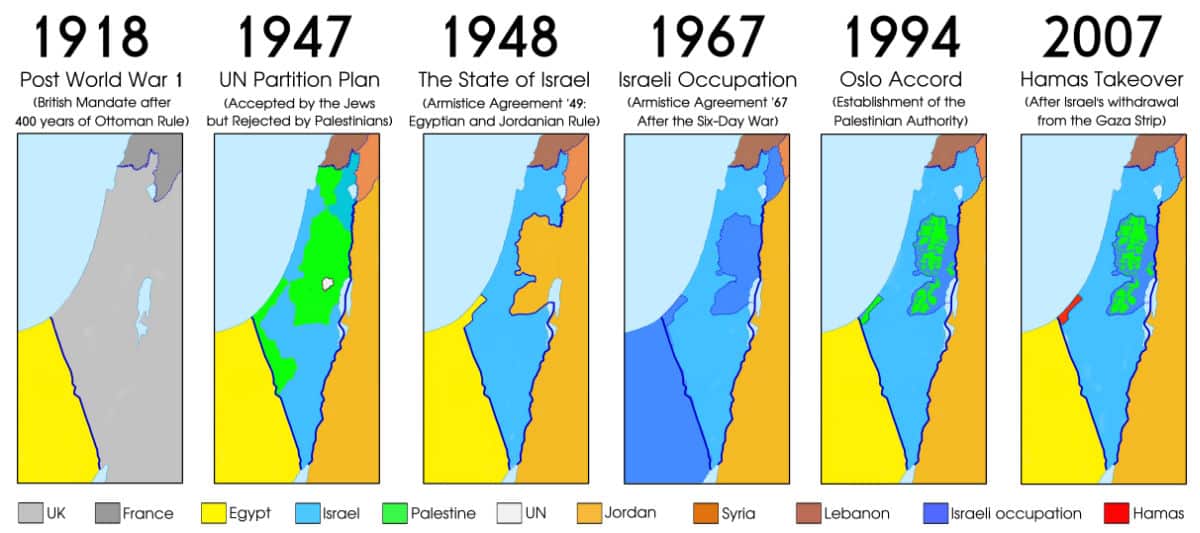
In 1918, one year after the Balfour Declaration, a group of Arab leaders from Mandatory Palestine petitioned the French Commissariat in Jerusalem to include Palestine as part of Syria for historical and cultural reasons. In the ten-year period following the Balfour Declaration, only 40,000 Jews arrived in Palestine, and 1.5 million Jews migrated to the Americas, which indicates a comparative lack of enthusiasm for the Zionist project on the part of world Jewry. This Zionism can be traced to the worldview provided by the nineteenth century Jewish Enlightenment, or Haskalah. This movement called for Jewish integration in Europe and Jewish adoption of European secular knowledge and values while retaining Judaism. Under the tutelage of philosophers such as Elijah Benamozegh (1823-1900) and Leopold Zunz (1794-1886), Jewish education was modernized with secular studies promoted alongside traditional Talmudic learning. Jews were encouraged to adopt the languages, dress, and customs of their surrounding societies. Scientists with Jewish ancestry became recognized as global citizens. In the nineteenth century, Paul Ehrlich won a Nobel Prize in medicine, Gabriel Lippmann in physics and Adolf von Baeyer in chemistry. Sigmund Freud and Alfred Adler were (with Carl Jung) part of the triumvirate that founded modern psychology. Some, including Freud, became atheists. Others, including Adler, converted to Christianity. Others created religious reform movements within Judaism. Many turned to socialist, communist, union or social-activist movements. Karl Marx co-authored the Communist Manifesto. Ferdinand Lassalle founded the German Workers’ Association, Victor Adler founded the Democratic Socialist Party of Austria, and Paul Singer led the Social Democratic Party of Germany. Unlike Zionism, the Haskalah sought collective security by eliminating racial and ethnic identitarianism, and by emphasizing economic security, human rights and social justice. Pogroms continued, however, particularly in Eastern Europe, but with education, modernization and humanism, they thought, surely a better world would emerge. That hope was premature.
In 1920, three Jewish villages, Tel Hai, Kfar Giladi, and Metula, were destroyed by Arab terrorists in Palestine. Since there had not been, as yet, a significant influx of repatriated Jews, the terrorists could have been responding to the changed status of Jews under British rule. Under Ottoman rule, Jews (and Christians) had been required to show submission to the Islamic authority, but now, they were considered equal. The Jewish Palestinians responded to this pogrom by raising militias of their own. Thirteen Jewish villages were destroyed by the Arabs from 1920 to 1936. Although there are no recorded instances of Arab villages destroyed during this period, Jewish paramilitary forces attacked Arabs during the 1920 Nebi Musa (Arab) riots and the 1936 Arab revolt.
Although the Haskalah favoured Jewish migration to the West, that window of opportunity was closing. In Britain, the Aliens Act of 1905 had already restricted the entry of Jews, particularly those from Eastern Europe. The United States Immigration Act of 1924 established strict quotas on immigration from Eastern Europe including Jewish refugees from pogroms. In 1939, Canada, Cuba and the United States infamously denied entry to the Jewish refugees aboard the MS St. Louis, which meant that 907 Jews were returned to Europe with most ending up back in Nazi Germany. The experience of Thessaloniki, Greece, offers a glimpse of the unfolding tragedy.
The city’s Jewish population dates back to biblical times, having been mentioned by the Apostle Paul in First Thessalonians. The city’s Jewish population swelled with Sephardic refugees from the Spanish Inquisition in the fifteenth century. In the late nineteenth century the city’s Jewish population expanded further with Ashkenazi survivors of some 200 pogroms in Eastern Europe. Given natural increase, there likely were 120,000 Jews in the city by 1930. About half of them emigrated by 1939, when the British reached an agreement with the Arabs to restrict Jewish immigration to Palestine. The Nazis recorded 56,000 Jews in Thessaloniki when they captured the city in 1941. Only a few hundred survived.
Arabs ask why they should pay the price for Nazi atrocities by allowing the creation of a Jewish “refugee state.” The meeting between, Haj Amin al-Husseini. the Grand Mufti of Jerusalem. and Adolf Hitler in 1941, and his attempts to recruit Muslims for the Waffen SS can be seen as a continuation of the anti-Semitism that had already been historically present in Palestine. While Arabs have argued that the British allowed in too many Jewish refugees, a survivor from Thessaloniki would have argued that the British were harsh in allowing in so few. If the Arabs had formed the government, they might in theory have adopted a different refugee policy, but as this historical scan shows, the local Arab population did not form the government of this region and never had. Furthermore, it shows that Jews had lived there continuously for the past 3,000 years. Finally, Arabs assume that the Jewish refugees came from Europe, but the nine Arab countries created in the aftermath of World War II expelled nearly 600,000 Jews. Only a minority of Israel’s Jewish population are descended from Europe’s Ashkenazim.
In 1947, the United Nations proposed a partition plan that would establish two states in Palestine, one for Jews and another for Arabs, according to population density. Under this plan Jerusalem would be an international city with separate governance. The Jewish Palestinians accepted this partition and named their new state “Israel.” The Arab leaders did not accept this “two-state” solution and a civil war broke out between the paramilitary forces on both sides. The Israeli military plan was to disable the local Arab forces before the armies from the surrounding Arab states of Egypt, Transjordan, Syria, Lebanon, Saudi Arabia and Yemen arrived. By war’s end, about 700,000 of the Arabs in Israel had fled, forcibly displaced or encouraged by their leaders to leave with the promise of a right of return after an Arab victory. According to the partition plan, the area designated as the Arab state had a population of approximately 1,181,000 consisting of 630,000 Muslims, 143,000 Christians, and 408,000 Jews. Between the ethnic cleansing of Jews by the surrounding Arab states and those in Arab Palestine, the new state of Israel absorbed a million Jewish refugees.
The new Israeli government was dominated by leftists and socialists of the Haskalah tradition. In many ways, they established a modern secular state with accommodations for religious orthodoxy. For example, while government offices are closed on the Sabbath, the “basic laws” under which Israeli courts and government operation include: the right to life, personal liberty and property; the right to engage in any profession or occupation; equality before the law including a prohibition of discrimination on the basis of race, religion, nationality, or gender; and, freedom of religion.
The 150,000 Arab Palestinians who remained in Israel after 1948 were granted full citizenship and their language had official status, although they remained under military administration until 1966. Their descendants now number about 2.1 million, comprising about 20% of Israel’s population. They have their own political parties with representation in Israel’s parliament. They serve at all levels of governance including the country’s Supreme Court. They face discrimination, because not all Israelis believe that they can be trusted given their ethnic and religious connections with those Palestinians seeking to destroy the Israeli state.
In the concluding section to be published in the next issue of Humanist Perspectives we will examine the role of religion in this conflict and lay out a humanist path to peace. 