

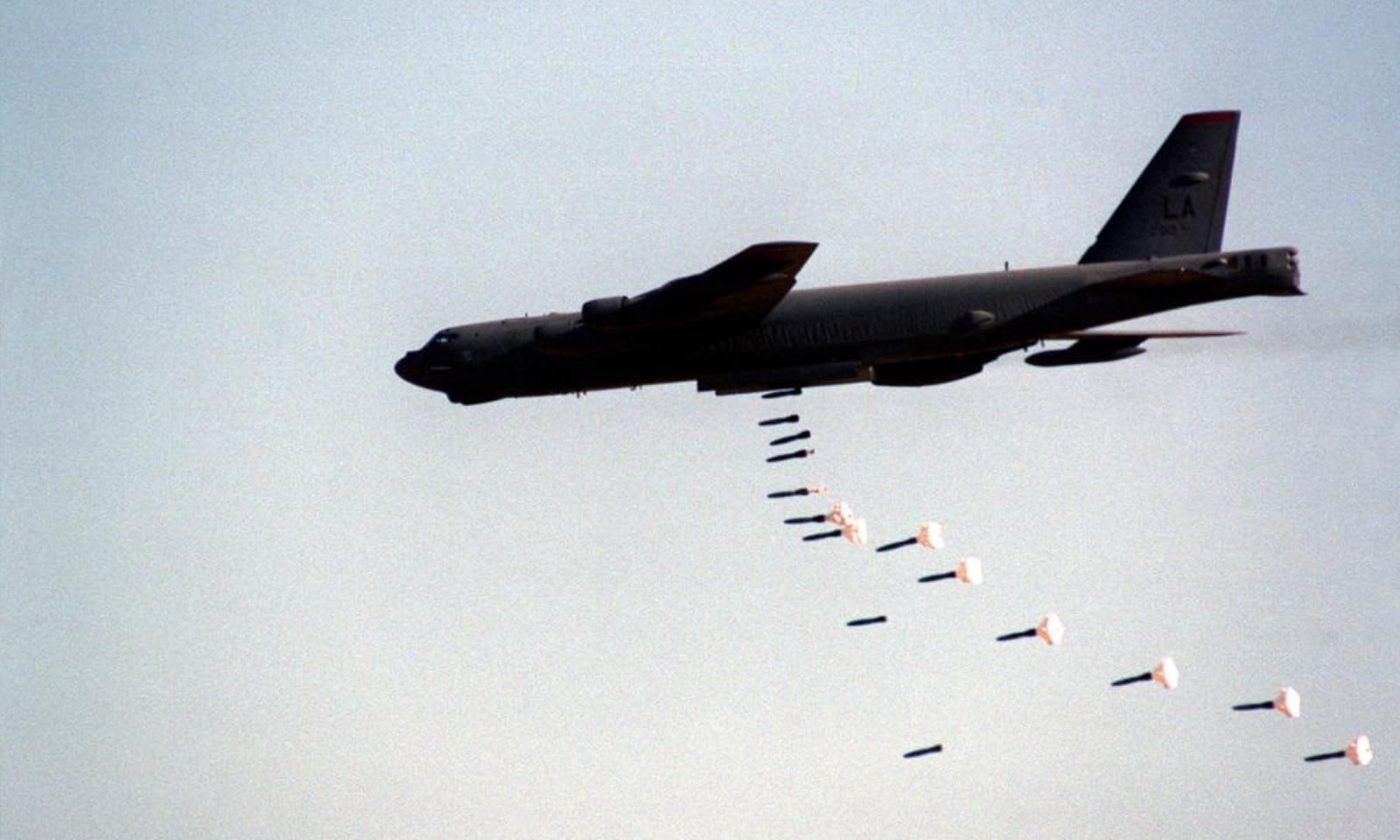
An alarming prophecy crystallized in the mind of an Italian army general at the turn of the last century: victory in future wars would demand combat aircraft capable of “dumping the largest quantity of bombs in the shortest time.”


An alarming prophecy crystallized in the mind of an Italian army general at the turn of the last century: victory in future wars would demand combat aircraft capable of “dumping the largest quantity of bombs in the shortest time.” When that forward-looking general, Giulio Douhet, assumed command of Italy’s fledgling air battalion, it had already achieved a military first. In the Italo-Turkish War, an intrepid pilot with that unit pulled off the first ever aerial bombardment, tossing four hand grenades from his monoplane onto enemy targets near Tripoli. In a letter to his father, aviator Gavotti confided that he was very pleased with his historic feat. For his daring exploit in Italy’s imperial war, he received a silver medal of valour.
The greater role that bombers played in the First World War sharpened General Douhet’s conviction that the air force capable of destroying enemy warplanes “in airfields, in hangars, in factories” would enjoy a “decisive advantage,” if not shining victory itself. In the twenty-first century, air supremacy looks like an American supersonic fighter-bomber. While commander Douhet couldn’t have foreseen a combat jet amped up with cutting-edge avionics and sensors, like the stealth F-35, he had an inkling that building the warplane of tomorrow would require the “riches of America.”
Shrewd martial theorists like Douhet base their predictions on good historical evidence: to project power, wealthy nations arm themselves to the teeth, even while flirting with bankruptcy. The U.S., history’s greatest military spender, burns through literally trillions on warplanes and the various bombs — the nuclear B-61 among them — earmarked for precision strikes from the air. Money deserves its fame as “the most powerful of all weapons in warfare.”
The capture of Venezuelan leader Nicolás Maduro in January 2026 to face drug-trafficking charges confirms Douhet’s hunch that an air force in control of enemy airspace will “wield offensive power so great it defies human imagination.” U.S. forces struck multiple targets in and around the Venezuelan capital of Caracas using over 150 fighters, bombers, and other support aircraft, including the F-35, a wondrous radar-evading aircraft that surely measures up to an Italian general’s 100-year-old daydream of a “true combat plane able to impose its will upon the enemy.” Venezuelan air defences didn’t stand a chance against an aircraft that can fly undetected through enemy airspace.
The bright future that Douhet predicted for his vaunted “art of aerial warfare” included its potential for unprecedented, massive destruction. He warned in 1921 that since bombers can target cities and towns as easily as military sites “all citizens wherever they are, can be victims of an enemy offensive.” The centuries-old line of demarcation separating soldiers on the battlefield from citizens in their homes would become as irrelevant as the catapult, chain-mail armour, and the muzzle-loading rifle. “There will no longer be any distinction,” prophesied the Italian oracle-general, “between soldiers and civilians.”
Douhet’s prediction came horribly true only a decade after his death with the massive bombing conducted by both sides in the Second World War. Just two examples of that war’s countless atrocities will do. Hundreds of German warplanes dropped 30,000 incendiary bombs on Coventry, England, in November 1940, killing over 500 defenceless citizens. The American nuclear bombs dropped onto Hiroshima and Nagasaki in August 1945 claimed 170,000 civilian lives.
One hundred years before those deliberate strikes on the unarmed, the rifle replaced the clumsy musket on the battlefield, which made it easier to kill soldiers. And it was at that pivotal juncture in the unrelenting quest for ever-deadlier weaponry that philosopher Pierre-Joseph Proudhon wondered, “Is war allowed to resort to any sort of homicidal instrument?”
A militarist rather than philosopher, General Douhet didn’t share Proudhon’s humanitarian qualms. He had no doubt that any weapon, “no matter how inhuman and atrocious,” would be put to use someday because “victory comes only through inflicting more damage than one suffers.” For warriors like Douhet, the winged goddess of ancient victories flies alongside advanced warplanes dropping the biggest bombs. Described by President Harry Truman as “the most terrible weapon ever known in human history,” the atomic bombs dropped by American B-29s on Japan forced it to surrender unconditionally.
A military maxim attributed to Roman General Pompey is as pertinent today as it was in the first century BCE: all laws are silent in the time of war. International law — likened by German philosopher Immanuel Kant to a “peace institution” established to avert war — prohibits attacks on civilians and civilian infrastructure. But a military objective, once conceived by an imperialist like Russian President Vladimir Putin, won’t yield to legal or moral imperatives to protect noncombatants. He craves Ukraine’s complete assimilation into a greater Russia, whatever the cost in Russian and Ukrainian lives.
According to the Office of the High Commissioner for Human Rights, Putin’s all-out war has, as of March 2026, killed over 15,000 Ukrainian civilians and injured over 41,000. His goal has been to spread terror with large-scale air strikes on all manner of civilian infrastructure, from residential buildings to hospitals, from schools to electrical stations. The Kremlin has taken to heart General Douhet’s 100-year-old advice: “No population can steel itself enough to endure aerial offensives forever.”
But Russia’s superior air power hasn’t yet crushed, after more than four years of grinding war, a people’s determination to fight for their homeland. Putin underestimated the strength of Ukraine’s national pride. Not all power lies with the sword.
As in Putin’s war against Ukraine, so too in the Israel-Hamas war: a defenseless population bears the brunt of a mighty air power hell-bent on achieving a maximalist military objective. In only the first month of the conflict, Israeli fighter jets dropped about 6,000 bombs on Gaza. The civilian death toll after two years of relentless air strikes on the densely populated enclave stood, as of November 2025, at over 70,000. Unlike their civilian counterparts under bombardment in Ukraine, ordinary Gazans, incapable of doing anybody any harm, couldn’t even take refuge in bomb shelters because there aren’t any.
Israel’s military firepower — unleashed full-force after the terrorist massacres of October 7, 2023 — has also reduced Gaza to rubble. A report to the UN Human Rights Council in February 2026 states: “Indeed, the level and scale of destruction of housing and civilian infrastructure in Gaza is unprecedented even by the terrible standards of modern warfare since the 20th century. The level of destruction rivals that of other bombing campaigns in history.” Raw military power, unleashed with impunity for two years, has left Gaza’s cities in total ruin.
This limited survey of bombing raids ends with the latest as of this writing. On February 28, 2026, the combined air forces of Israel and the U.S. launched a second war against Iran in less than a year. They quickly established control of Iranian airspace, confirming the military tactic forecast by Signor Douhet for getting “positive and very great results from aerial bombardment.”
On that war’s first day, a U.S. missile destroyed a school in Minab in southern Iran, killing up to 175, mostly children. Since then, U.S. and Israeli air strikes have blown up countless civilian structures: housing complexes, energy installations, hospitals, historic sites, courthouses, and shops and cafes. Unlike their civilian counterparts in Israel who can take refuge in bomb shelters from incoming missiles, Iranians have no such state-provided protection.
Just as our favourite oracle-general predicted a hundred years ago in his military treatise, The Command of the Air, dropping bombs from the sky has become a warring nation’s best chance for success. “Does the thought of so horrible a form of war shock our sensibilities?” Douhet asked, before shrugging off its looming horrors: “Well, let it be so.” An international ban on aerial bombing, and how to achieve it, never entered his mind. The human capacity for resignation appears to be strong among militarists.
The latest supplement to Douhet’s “third branch of the art of war” is the uncrewed drone, which has reduced the need for manned aircraft to do the bombing. But what drone warfare underscores is what air warfare revealed even in its infancy a century ago. The mighty of the earth equipped to control the skies over enemy territory with fighter jets and more recent technologies — today that would be Russia, Israel, and the U.S. — will stop at nothing to crush their foes, even if defenseless civilians in Ukraine, Gaza, and Iran, all members of one human race, pay the ultimate price. War’s sycophants accept civilian casualties as a normal after-effect of bombing raids, mere collateral damage. “War is war,” wrote Signor Douhet, without challenging the presumed wisdom of that oft-repeated tautology. “[O]ne must do it without gloves and without frills.”
After pilot Gavotti tossed that historic bomb out of his warplane, a “small dark cloud” rising above the military tents in the Libyan oasis far below confirmed that he’d hit his target. But he had no way of knowing if the explosion killed or wounded any unsuspecting civilians living nearby. Despite modern propaganda about the marvels of “precision” strikes, air bombing today is just as blind, and as barbaric, as it was at that turning point in 1911 when the aerial war against civilians first began. 