

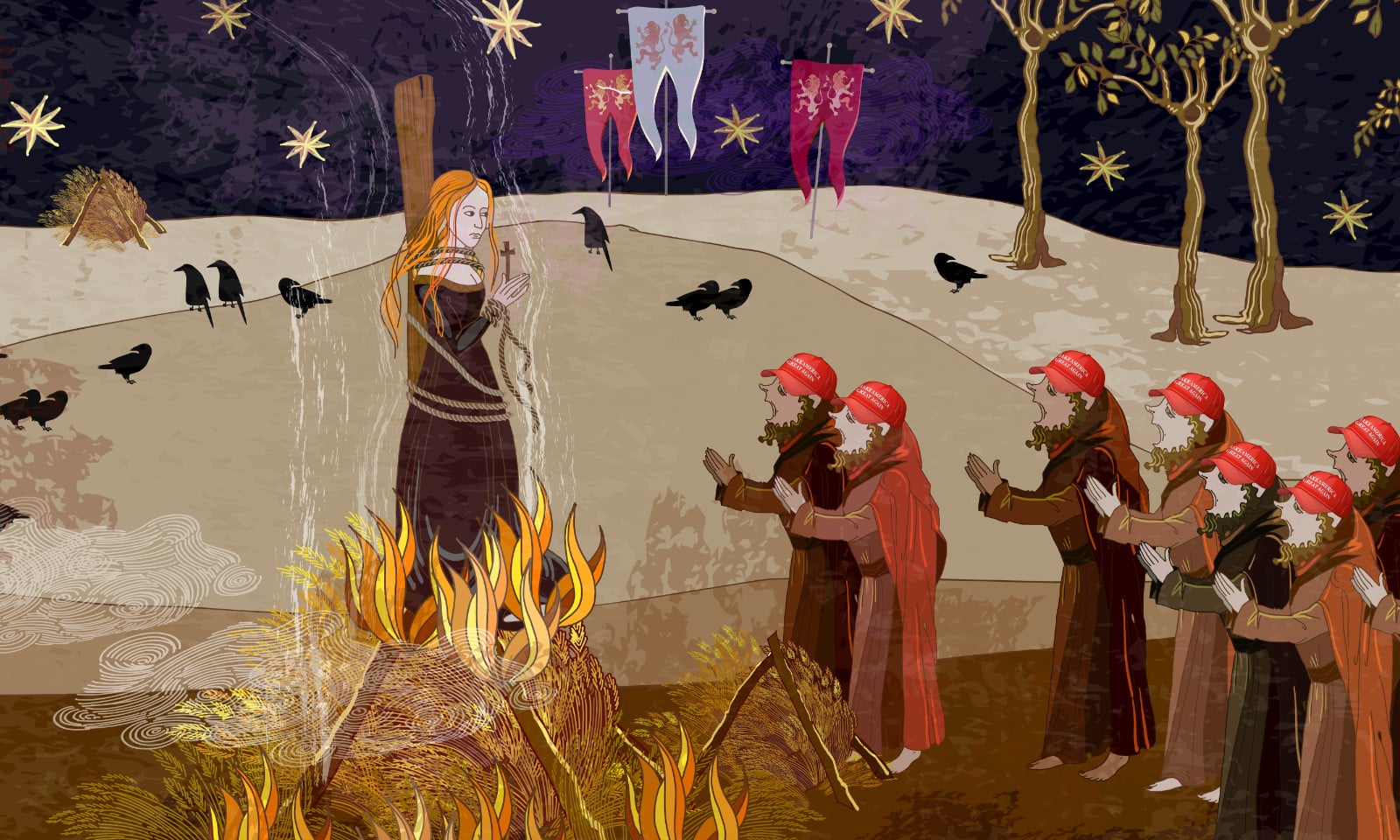
To say a person’s dignity has been wounded may leave many confused and thus unconvinced. To point out that, and how, they have been humiliated, may well prove much more effective.


One of the signal markers of a democracy lies in the relationship of the individual to the state. In a democracy the individual constitutes the heart of the state. In the famous words of Abraham Lincoln’s Gettysburg Address, a “nation conceived in liberty,” i.e., a democracy, “is a government of the people, by the people, for the people.”
The citizen of a democracy does not stand as a supplicant before those in office and that is part of what it means to have one’s dignity respected by the law. That citizen is a bearer of rights, rights that can only be limited in a democratically acceptable way. Section 7 of the Canadian Charter of Rights and Freedoms puts it well: “Everyone has the right to life, liberty and security of the person and the right not to be deprived thereof except in accordance with the principles of fundamental justice.” Canadians can be deprived by the state, for example, of our liberty – we can be imprisoned or have our liberty constrained in other ways – but only in a manner that is consistent with “fundamental justice,” a concept which is spelled out case by case by the courts.
In a democracy our dignity is supposed to be protected by such legal mechanisms. But those mechanisms are only as effective as the people who fulfill the roles meant to enforce them. And we are currently witnessing behavior dramatically inconsistent with democracy on the part of people in high public office in the United States, including and in particular, the president; behavior that is leading many commentators to claim the erosion of democracy there and perhaps its demise.1 Perhaps the most pressing question about this crisis is: Will Americans let it happen? A key unknown is what will, or might, motivate Americans to stand up for that democracy.
One source of motivation could be reminders of, or lessons on, what it actually feels like to live in a state where your dignity is neither recognized, nor respected, and where you live at the whim of those with political power; where the possibility of humiliation in the public arena is ever present.
On dignity
Much has been written about the importance of human rights laws to the recognition and protection of a person’s dignity. But the concept of dignity has proven difficult to spell out clearly over time. In their 2011 paper, “Human Dignity, Self-Worth and Humiliation: A Comparative Legal-Psychological Approach,”2 Doron Shultziner and Itai Rabinovici address this difficulty.
“… [D]ignity is a central concept in many legal systems. Yet the increasing and sometimes excessive use of this concept has generated a number of serious problems which have only recently become clear in empirical research and court rulings showing that the meanings of dignity have become contradictory and can no longer advance human rights protections.
The authors observe that,
In Canada, where the concept of human dignity has been vigorously employed, Supreme Court justices have recently reached the conclusion that it is too abstract, subjective, confusing and difficult to apply as a legal test, and that “it has also proven to be an additional burden on equality claimants, rather than the philosophical enhancement it was intended to be.”
Shultziner and Rabinovici offer an alternative approach which focuses not on dignity per se but instead on violations of it. This seems to me promising because often in life, while understanding the positive may prove elusive – what is happiness? – focusing on the negative – unhappiness – may well prove much more useful. To say a person’s dignity has been wounded may leave many confused and thus unconvinced. To point out that, and how, they have been humiliated, may well prove much more effective.
Shultziner and Rabinovici describe their work in this area as being
… anchored in the psychology of the self, specifically in the human need for maintaining positive self-worth. We elaborate [in the paper] on what this conceptualization means in terms of violations of dignity, emphasizing dignity’s antonym, humiliation, as well as other closely related aspects of social exclusion, lowering of social status, and denials of recognition more generally.”
We have all had highly embarrassing, if not full on humiliating experiences, in our everyday lives. I was caught smoking in the bathroom by a teacher who had up until then been a real fan. But it is one thing to feel a sudden drop in status in high school. It is quite another thing to face the same in your public, adult life, where your very liberty may be at stake.
When the law protects your rights, you have something to stand on. When it doesn’t, you are left to the law of the jungle, where only might makes right. The contrast is between standing with dignity on your rights to face whatever in the system is threatening you and groveling before power. And how does it feel to have to grovel before power? It is humiliating and feels terrible.
Different legal cultures, different levels of exposure to humiliation
For those that have lived in countries with the rule of law and thus genuine protection of at least some human rights, the idea of having to grovel before persons in authority is not, for most of us, very familiar. But we need to take a moment here and acknowledge that even in a country such as Canada, not everyone gets the same treatment. I remember a friend of one of my daughters talking about why he didn’t drive a car in Montreal: DWB (Driving While Black) was an “offense” to which he wasn’t willing to make himself susceptible. Even if he didn’t get a traffic ticket, the humiliation of being stopped for a supposed infraction in circumstances where white people were not being stopped, was just too unbearable to contemplate. And the parallel examples in Canada involving Indigenous people over the years are, sadly, legion.
Yes, we have to accept the above, but also have to acknowledge that, in general, the Canadian experience of engaging with authority is a far cry from what so many in the world experience.
Take Russia, for example
What is that other world like? My only extensive exposure to a country without the rule of law grew out of about 16 years of working on law reform projects in Russia. The bulk of the work was carried out between 1994 and 2006; years between the dissolution of the Soviet Union and Putin’s emergence as an outright dictator. In the course of this work I made several good Russian friends whom I observed, some of them on multiple occasions, engaging with authority figures. These were often, for me, crushing experiences as I listened to these intelligent, talented people kowtow to those they should have been able to speak to in a normal way. These conversations did not concern life or death matters, not even close. They were just run of the mill suck-ups to someone, whom in Canadian circumstances, my friends could have dealt with in a straightforward manner. But a Russian couldn’t trust that the person in authority would not abuse their authority – for example, to extract a bribe – so they sucked up. They metaphorically got on their knees before them.
This is so common in a society such as Russia that many a Russian wouldn’t even have noticed what I observed as degradation. They are used to having to behave in this way; they are brought up to expect it. But that doesn’t mean it isn’t wrong or damaging. During the years when Canadian women did not have the right to vote, many women simply accepted that state of affairs as “the way things are.” But that did not mean they were not degraded by their exclusion. Russians are damaged by having constantly to degrade themselves before people in authority.
But the situation is much, much graver in a country such as Russia than the above humdrum sort of example suggests. Because without the rule of law, when you engage with someone in authority, there is always some element of fear. This fear stems from never knowing when something seriously bad might happen. As David Brooks recently observed3 in a piece called “Imagining What’s in Trump’s Brain,” the authoritarian is “unpredictable because nothing reduces people to submission as quickly as the threat of random punishment.”
The Khodorkovsky case: a classic Russian show trial
Mikhail Khodorkovsky, a Russian billionaire who had contributed large amounts of money to fund the development of a western-friendly, democratic political movement in Russia, was arrested in 2013 by the Putin-led government. He was arrested not for any offenses he might actually have committed, even though he might well have committed some back in the chaotic days directly after the fall of the Soviet Union. Instead, he was prosecuted because Putin had determined it was time to reinforce an old lesson: it is clear that Khodorkovsky’s subsequent trial and imprisonment for 10 years (he was only released, and exiled from Russia, when his continued imprisonment in the lead up to the 2014 Sochi Olympics might have become a source of unwanted media attention) was meant to serve as a “show trial.” The Soviets had become expert at staging fake trials on fabricated charges to show they had complete power over the population. They used the law (and other tools) to cow Soviet citizens into submission.
I arrived in Moscow within days of Khodorkovsky’s arrest and observed to our Russian driver, Andrei, in amazement – because virtually everyone had thought the extremely wealthy Khodorkovsky to be a very powerful person, indeed – that if they can do this to Khodorkovsky, they could do the same to anyone. No doubt stifling a less diplomatic response, Andrei commented quietly “We all know this, Janet.”
An example from closer to home: the indictment of James Comey, and the firing of his daughter
These days we don’t have to go anywhere near as far as Russia to find examples of the law being used in an unpredictable manner to humiliate political opponents and teach authoritarian lessons. The indictment in September 2025 of James Comey for allegedly lying to Congress and obstructing a Congressional inquiry is widely viewed as a political prosecution, that is, as an effort by Trump to exact revenge for Comey’s role in the investigation into Russia’s support for Trump in the 2016 presidential election. If a former head of the FBI can be treated in such a fashion, what message does that send to other Americans about how they stand before their government? Can they feel secure as rights bearers in an intact democracy, or are they now supplicants, having constantly to please the great man and his minions?
The persecution of Comey does not end with these indictments. Horrifyingly, it has been extended to his family. Jeffrey Toobin recently wrote of this in the New York Times:4
The government of North Korea practices “kin punishment,” which means that the state penalizes those who commit political offenses and their relatives as well. With at least one prominent family, the Trump administration has apparently adopted a similar model.
…
Maurene Comey, [James Comey’s] eldest daughter, was fired July 16 [2025] by the Justice Department from her position as a career federal prosecutor, …
Ms. Comey, Toobin tells us, “has maintained that there was never any allegation, much less proof, offered to her that her performance was deficient.” Indeed, the very opposite seems to have been the case:
[S]he had an impeccable record as a prosecutor. Through her decade of service, she received consistently “outstanding” performance reviews, and she was promoted to leadership positions within the Southern District office. She handled some of the department’s highest-profile cases,
“So why was she fired?”:
Throughout 2025, Ms. Comey was a target of Laura Loomer, the right-wing social media influencer whose public denunciations of several members of the Trump administration, including Gen. Timothy Haugh, director of the National Security Agency, led to their dismissals. Ms. Loomer has positioned herself as the president’s protector and uses her presence on social media to lead the charge against those she accuses of insufficient loyalty to the commander in chief [i.e., Trump]. Ms. Loomer called for Ms. Comey to be fired as a “national security risk” because of her “proximity to a criminal,” that is, her father.
Ms. Comey is suing the federal government arguing his firing was made without legitimate cause and thus contrary to the laws pertaining to the federal Civil Service.
In conclusion: James Comey’s advice
After the announcement of his indictment, Comey went public, insisting on his innocence, but also commenting on the element of political persecution inherent in his case. He said that he and his family always knew there could be a price to be paid for “standing up” to Trump, but “We will not live on our knees, and you shouldn’t either. …[F]ear is the tool of a tyrant. … But I’m not afraid, and I hope you aren’t either.” Rather, he encouraged Americans to be engaged, to pay attention and to vote. 
- For many people, myself included, the test will be the 2026 mid-term elections and, if it is held, the presidential election in 2028.[↩]
- Human Dignity, Self-Worth and Humiliation: A Comparative Legal-Psychological Approach by Doron Shultziner, Itai Rabinovici :: SSRN[↩]
- https://www.nytimes.com/2025/11/07/opinion/trump-putin-authoritarianism.html?searchResultPosition=1[↩]
- https://www.nytimes.com/2025/11/13/opinion/trump-comey-james-maurene.html?searchResultPosition=1[↩]