Humanist Perspectives: issue 210: Dancing with Shakespeare
Dancing with Shakespeare
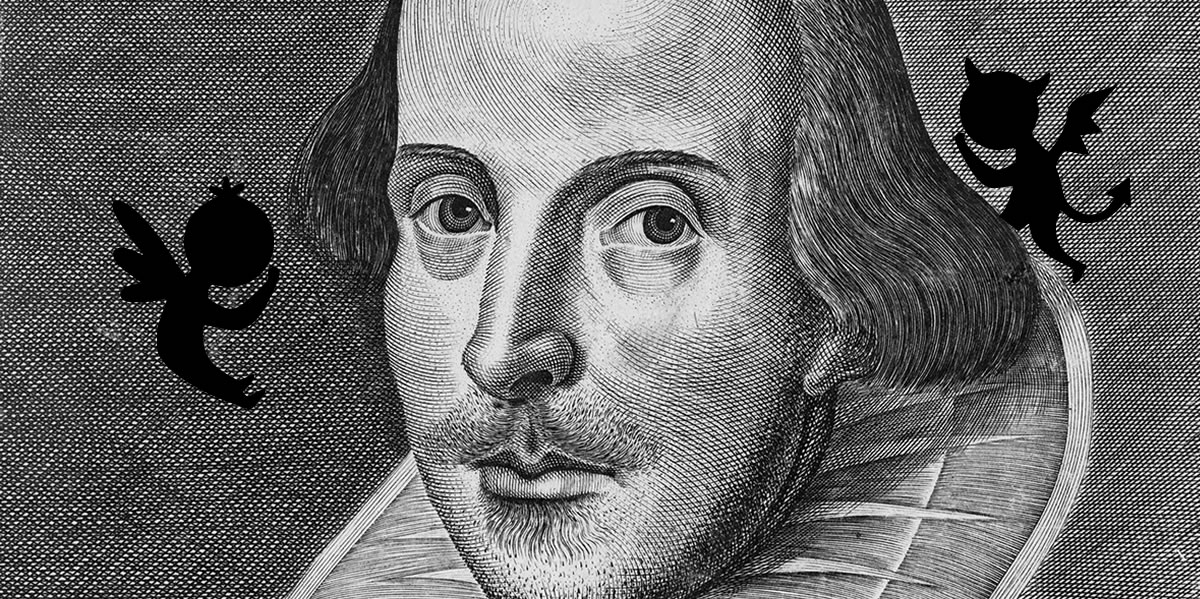

hen I was young and wondering about what to do with this precious life that had been given to me, I thought about becoming a writer. However, I somehow knew that if I did, I would also develop the habit of observing myself as I was living my life. I could have no pleasure without observing that I was having pleasure. Everything would become second-hand and, I feared, second-rate.
And then of course William Shakespeare had something to say about it, as he normally does. He incorporated double-mindedness in a wicked sonnet (Sonnet 144):
Which like two spirits do suggest me still;
The better angel is a man right fair,
The worser spirit a woman colour’d ill.
To win me soon to hell, my female evil
Tempteth my better angel from my side,
And would corrupt my saint to be a devil,
Wooing his purity with her foul pride.
And, whether that my angel be turn’d fiend,
Suspect I may, yet not directly tell;
But being both from me, both to each friend,
I guess one angel in another’s hell.
Yet this shall I ne’er know, but live in doubt,
Till my bad angel fire my good one out.
Shakespeare’s better angel is a man “right fair” wooing him to comfort; and the worser spirit is a woman “colour’d ill” who would “corrupt my saint to be a devil,” leading him toward despair.
To free himself of this tension, the poet proposes a solution by way of a conundrum. In language so compressed it is nearly incomprehensible, he says that he suspects, but can “not directly tell” that “my angel be turn’d fiend,” while each angel continues as his friend and as a friend to the other angel. And here is the point of the conundrum and the poem, in my opinion: if the two tempters, female-evil and man-saint are actually friends, and if Shakespeare must live in doubt “until my bad angel fire my good one out,” then why is the resolution that “ my bad angel fire my good one out?”
According to conventional thought, Shakespeare has got it the wrong way around. Surely the good angel should win? Studying this, I wondered if Shakespeare disguises the good as evil and the evil as good and makes them friends so his poem can avoid consigning anyone to hell. The whole poem is an argument with himself which he resolves by disguising enemies as friends and vice versa, as if each is only an actor assuming a role for the term of the poem, which he or she can at the end of the play (sonnet) discard without lasting effect.
This enables him apparently to respect but actually to reject the church’s doctrine that once one knows the Christian choice, one must decide between the devilish spirit and the good spirit, or else be punished. But the poem specifically rejects that threat by making the two spirits friends, while each is disguised as the other1
Thus the world that is split in two by church dogma is reunited by Shakespeare. In his London place and his Elizabethan time (circa 1599 CE) this was dangerous writing, which may be why he made it gnomic. If his enemies prevailed, Shakespeare was in danger of being tortured and hanged.
Then why write it? According to a lot of writers, we do it, “because this is all there is.”2 Sonnet 144 is Shakespeare’s cloaked message to the future, in parallel with these lines which he openly predicted would be immortal (Sonnet 18):
When in eternal lines to time thou grow’st,
So long as men can breathe or eyes can see,
So long lives this, and this gives life to thee.
Similarly at the end of Sonnet 144, he is freed of the power that the church has over him without ever having challenged it “directly.” Shakespeare is risking his life in a game whose rules are determined by eternity and the church. That is why the bad angel must expel the good one. If the poem did not (apparently) make the bad angel the victor, Shakespeare would not be challenging the church, however gnomically. It is his purpose to re-unite humanity in the spirit of the new humanism. He thus defies the church which has ruled for centuries by dividing people in order to denominate some as sinners. Shakespeare has defied it by sacrificing what was to him a minor point so that he can get away with the important point: he, not the church, is free to choose between good and evil3 The only punishment if he refuses to choose is existential doubt. This minor loss he accepts as his fate, instead of hanging or personal damnation in the church’s hereafter which he scarce believes but need not bother to defy.
To be true to himself, which to him is everything (“Thou canst not then be false to any man”), he has to refuse the church’s command to choose between good and evil. Then he is OK. His nimble wit saves him from a dilemma very like the hypocrisy that plain-spoken Montaigne faced, deplored and could not escape.
With that refusal to obey, expressed in that amazing sonnet, Shakespeare skates free of medieval thinking. He is perhaps one of the world’s first subjective thinkers, ie, those who know that they are thinking while they are thinking and can improve their thinking by thinking. Montaigne of course knew about this but could not use it to advantage as Shakespeare does.
Everyone alive today who may feel that he/she is above all that, free of church dogma, free to think freely, has many people to thank, Shakespeare among them.
Accepting this interpretation, one is free to see the mind of Shakespeare as ending the medieval era and as starting the revolutionary era of double-minds. The church, hitherto the mainstay of society and of traditional thought, is from now on being dismissed by the new rational modern mind, which is dispelling ancient beliefs such as the belief in ghosts, that thinning vestige of the early, God-driven bicameral mind. Hamlet, on the battlements of Elsinore talking to the ghost of his father, does this with a joke, “Well said, old mole, canst work in the earth so fast?” This must have cracked up the groundlings in the Globe Theatre who knew the players were thumping their staffs on a hollow wooden floor. 
- This reasoning is somewhat supported by another sonnet, 42, which after a long taradiddle back and forth very much like the back-and-forth of Sonnet 144, ends Sweet flattery, then she loves but me alone.
- See James Salter and James Bacque friendship, in Bacque, Nice Light Work, in progress.
- It would be presumptuous of me to add what is possible, that Shakespeare has here liberated all mankind from the evil which is the church creating sin in order to have sinners