Humanist Perspectives: issue 184: Jean Meslier’s Revolutionary Views on Christianity
Jean Meslier’s Revolutionary Views on Christianity
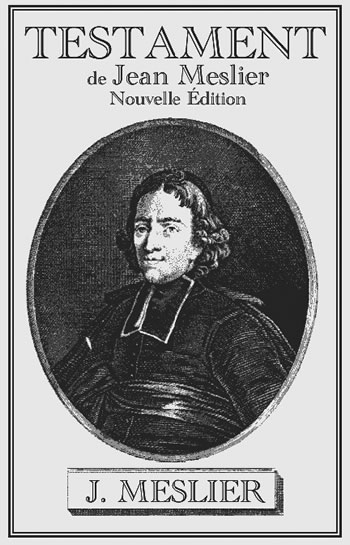
n 1728, the French curate Jean Meslier (1664-1729) completed a treatise entitled Testament: Memoir of the Thoughts and Sentiments of Jean Meslier. It consisted of ninety-seven chapters written with a goose quill pen by candlelight, taking ten years to complete. In this compendium he outlines the absurdities of Christianity and the Church by deconstructing the scriptures, the Bible, miracles, Jesus, the Trinity, the Eucharist, the Catholic Church and a supernatural God.
Meslier was among the first to call Christianity a fraud. He insisted, quite understandably, that the Testament not be published until after his death. (They were still occasionally burning people at the stake for heresy). An abridged version was soon published by Voltaire (1694-1778) but Voltaire, being a Deist, did not completely capture the non-theistic thinking of Meslier. In 1772, an abstract by the philosophe Baron d’Holbach (1723-1789) entitled Superstition in all Ages, (Common Sense) was published. This abstract, along with Voltaire’s, was translated into English by Miss Anna Knoop in 1878. A complete printing of the original Testament in French was apparently not published until 1846. The entire Testament was not published in English until 2009 by Paris translator Michael Shreve, and it is from this 595 page volume that most of Meslier’s thoughts and opinions were obtained for this article.

For forty years, Jean Meslier was a curate at the small village of Étrépigny in Champagne, France, and vicar of a little annexed parish named Bue. He did not particularly want to be a priest, but became one to please his parents. He was remarkable for the austerity of his habits. Devoted to his duties, every year he gave what remained of his salary to the poor of his parishes. Enthusiastic and rigid of virtue, he was very temperate, as much in regard to his appetite as in his relation to women. At his death his parishioners were surprised to find in his house three manuscripts, each containing three hundred and sixty-six pages, all written by his hand, signed and entitled My Testament. Meslier, who wholly abjured religious dogmas, left these writings as a last will and testament to his parishioners and to the world. It is regrettable that a complete volume in English was not published until 2009 because this work, as the well-known French philosopher and atheist Michel Onfray has stated, is truly a time bomb. While the original French text is occasionally disjointed and somewhat repetitious (Voltaire called it convoluted), the English version has been edited to make it more readable without detracting from the message. It is, I believe, truly fortunate that the ultra-intelligent Meslier was trained as a priest, because this enabled him to observe the spuriousness of Christianity and the Catholic Church first hand, and then leave his revolutionary conclusions to posterity. Meslier explains his reason for writing the Testament by quoting the Bible.
I saw under the sun that in the place of justice, wickedness was there, and in place of righteousness, wickedness was there as well. (Ecclesiastes 3:16).
– Jean Meslier
It is thought that Meslier had no more than fifty books in his library, but what a library! From reading the Testament it is evident he was familiar with the myths of Egypt, Greece and Rome, the teachings of Confucius and Buddha, the works of the major Greek and Roman philosophers, as well as the works of the French Renaissance writers, particularly Michel Montaigne. Montaigne is perhaps best known for his quote, “Men cannot make a mite, yet they make gods by the dozens.” He was Meslier’s greatly admired hero, and with the exception of the Bible, quotes him more than any other source. Meslier’s knowledge of the Bible was of course prodigious, and he acknowledges that as well as containing many fallacies, the Bible also contains much wisdom. Being a priest, he had an understanding of Latin, but we do not know if he could read Greek. It is obvious that if he had known as much about science as we know today, some of the sections of the Testament would have been much shorter, and his explanations of natural phenomena would be less convoluted and somewhat clearer. He does not appear to have read Newton, and thus has no concept of the laws of gravity and motion.
In his writings, Meslier makes clear that religions, as well as heaven and hell, are all human inventions, used by priests and rulers, “to keep a tight rein on the community of men and do with them whatever they wanted.” His logic is straightforward. Since there are so many different religions in the world, all claiming to be the one and only “real and perfect” religion, it is impossible for an independent observer to reason that any one of them is perfect and created by a deity. Therefore, they are all human inventions, with no exceptions. He calls them “false” and a “fraud” and “full of mysterious delusions, errors and impostures.” He calls the priests “pious morons.” And he mentions the famous quote, often attributed to Denis Diderot, but really first stated by Meslier: “All the rulers of the earth and all the nobles should be hanged with the entrails of priests.” He also mentions the quote of several popes (Julius III, Leo X and Boniface III) who stated: “Ah! How rich we are from this fable of Christ.” He goes on to say, “after my death let them call me an impious apostate, a blasphemer and an atheist, but I have seen the errors and impostures of religion, and the pride and injustice of the rulers that govern so imperiously and tyrannically over the earth.” Thus, throughout the Testament Meslier exposes the follies and forgeries of Christianity, many of which are still alive today. Some of these are profiled below.
Meslier says, “faith is a blind belief that serves as the foundation of all religions, and is only a principle of errors, illusions and impostures. It is a firm and confident belief in certain questionable laws and divine revelations. It is necessary for religions to allege this because it is this belief that gives them all the credibility and authority they have in the world, without which they would not be able to count on teaching or ordering people to do or practice their bidding. Faith is claimed to be the beginning and foundation of salvation, and is touted as the root of all justice and holiness, but in reality it is nothing more than an illusion.”
Meslier describes the prophets of the Old Testament as lunatics, fanatics, imposters and scoffers. They prophesized falsely in the name of God to deceive and seduce the simple and ignorant people. He justifies this harsh evaluation by noting that the things these men prophesied in the name of their God did not happen as they predicted, and on the contrary, everything turned to their disadvantage and confusion. On New Testament prophesies, Meslier is even harsher. “It was said that Jesus Christ, so-called redeemer or savior, would deliver his people from their sins. But since this prophesy has not been accomplished, it is false. It was said that this deliverance would avoid eternal punishment, but it did not prevent vice from occurring on earth. It did not deliver believers from the yoke of tyrannical leaders of the earth, and certainly not from the vain and crazy superstitions of religion. And the prophesy that Jesus would occupy the throne of David is clearly false, for it is certain that he was never on this throne and never reigned over the Jewish people.” Meslier goes on to cite, in total, seventeen so-called promises that Jesus Christ did not accomplish.
Christian doctrines, he declares, “are vain, laughable and childish. Yet it is on such vain and ridiculous foundations that the entire Christian religion rests and it is on these vain and ridiculous spiritual and allegorical interpretations, that our Christ-cultists founded their so-called Holy Scriptures, and based all their mysteries, their doctrine and all their beautiful hopes on an eternally blissful life in a fictitious heaven.” Five errors of doctrines are listed – the Trinity, Christ as an incarnation of God, the Eucharist, the Garden of Eden, and the Flames of Hell. Here is what he has to say on the second one.
– Jean Meslier
The second doctrinal error concerns the incarnation of God becoming man. He dismisses the incarnation right away by stating that Jesus was only a man, and a mortal man like other men. He then calls Jesus “a nobody with no talent, no mind, no learning, no skill, low born, a wretched fanatic, a madman, a fool, a fiend, a seducer, and a miserable scoundrel who was nailed and hanged on a cross. He was a lunatic who imagined he was the son of God, born to deliver the Jews from captivity, become king of the Jews and after death would return to rule over God’s kingdom eternally on earth, where justice would reside.”
Meslier says the visions and wild thoughts of the famous fanatic Don Quixote, were never as crazy as those of Jesus, and he notes that after Jesus’ first speech in a synagogue in Nazareth, the admiration of the Jews turned to indignation and they wanted to throw him off a cliff. (Luke 4:28,29). He calls Jesus mentally deranged because he so vainly imagined and predicted so many great and beautiful things that never happened. Regarding the teachings of Jesus he says, “I feel safe in saying that even the fables of Aesop are certainly more ingenious and instructive than all those crude and low parables that are told in the Gospels.” Meslier then notes that in the beginning, Christianity was considered to be nothing but a madness and a vile and despicable fanaticism. He also mentions that in the early days of Christianity there was a saying in Italy that, “you have to be crazy to be a Christian.”
Jesus cursed the rich and those who enjoyed themselves and were happy in this world, and instead extolled those who were poor and hungry. Meslier said this was nonsense. There is no virtue in being poor and hungry, and humans have a right to be able to work toward the better things in life and achieve some level of happiness. And then there is the touchy subject of pre-marital sex. It is almost certain that Meslier was not a celibate priest. Church rules dictated that the housekeepers of priests had to be at least forty years old. On two different occasions Meslier had young girls as “housekeepers” and he got around the regulations by claiming they were his nieces.
Meslier considers it an error of Christian morality to condemn the natural pleasures of the body and asks “what benevolent God would want to make young people burn in hell for only having a few moments of pleasure together?” On the other hand, he did not condone promiscuity or debauchery. Moderation must be practised. Another error in Christian morality is the teaching that we must love our enemies. Just as it is natural to hate evil, it is also natural to hate those who unjustly do evil. For the public good, evildoers should be punished, not forgiven.
Meslier uses Richard Dawkins’ later argument that, since Christians do not believe that the multitude of pagan gods were real, and they also believe without question that the pagan gods were human inventions, it is only one further logical step to reason and believe that the monotheistic God of the Jews was also a human invention. He even claims that Moses himself invented God as a deceitful ploy to give himself authority over the Israelites.

Meslier adamantly rejects the Genesis creation story, and not being aware of the Big Bang theory, he postulates that, because it is impossible to create something out of nothing, the physical universe has always existed in its present state, and will continue to exist forever in that condition; therefore, it was not created by God. When it comes to living matter that is born and dies, he suggests that life was created by Nature herself and that living things were arranged and manifest in the wonders we observe all around us by this same Natural phenomenon. In a way he was foretelling Darwin’s theory of evolution by natural selection. He called it a system of natural formation.
Continuing his argument that there is no God, Meslier turns to an obvious observation. If there were a perfect, all-powerful, caring God, he should be able to take all kinds of benevolent actions to improve the conditions of humans on earth. For example, he would not allow humans to be born with birth defects, and he should be able to prevent evil and miseries, and also prevent people from being killed by natural disasters. Since there is no evidence of any of these benevolent actions, God evidently does not exist.
Meslier believes that after death we will all return to the state we were in before we were born. We will think about nothing, feel nothing and imagine nothing. So it is really in vain that the God-cultists and Christ-cultists boast of a great beatitude after death, since they will not even have a mind to think about beatitude or anything else. He turns to a wisdom passage in the Bible to substantiate this contention.
The living know at least that they will die, but the dead know nothing and they wait for no reward; no feelings of hatred or love or any desire at all affect them and they take part no longer in all that is done in the world. Go, then, in peace and joy to enjoy the goods that you have! Drink and eat the fruits of your labor in peace and rejoice with your friends and loved ones; for that is all the good you can hope for in life. (Ecclesiastes 9:5-9, as stated in Meslier’s Testament)So according to these verses in the Holy Book, it is a vanity and a deceitful presumption to wait for another life; consequently, there is no reward except in our present life. This passage from Ecclesiastes illustrates perfectly that it is possible to justify or prove just about anything you want, if you search the Bible diligently.
In place of the monarchy, Meslier advocated a system of equality, where property would be shared in common. In this regard he was a forerunner of Karl Marx and Friedrich Engels. He exhorts to workers, “work to unite all of you, as many as you are, you and your fellow men, to completely shake off the yoke of the tyrannical domination of your kings and princes. Overthrow the thrones of injustice and impiety everywhere. Break all the crowned heads! Confound everywhere the pride and haughtiness of all the proud and haughty tyrants. No longer allow them to rule over you in any way! Unite then, people, if you are wise! All of you unite, if you have a heart to deliver yourself from all your common miseries! Wake up and encourage each other to such a noble, generous, important and glorious undertaking such as this!” In recognition of his early advocacy for a form of communism, his name is inscribed, along with other communist pioneers, on an obelisk in Moscow.
– Jean Meslier
Near the end of the Testament, Meslier offers his profound thoughts on what a religions should be: “Hold no other religion among you but that of true wisdom and honest ways, no other but that of honour and propriety, of frankness and generosity of heart, no other but to completely abolish the tyranny and superstitious cult of the gods and their idols, no other but to maintain justice and equality everywhere, to completely banish the errors and impostures and to make truth, justice, and peace reign everywhere, no other but for all to be busy in some honest and useful exercise and to live orderly in common, to maintain public liberty at all times, and finally to love each other and keep peace and good union among you inviolably. You will be happy if you follow the rules, maxims, and precepts of this only wise and true religion. But I dare say, although I am no prophet, that you and your descendants will always be miserable and unhappy as long as you follow any religion other than this.” (Meslier uses the word “religion” where most humanists would prefer the terms “life stance” or “worldview” instead).
Here are a few of Meslier’s final thoughts: “And so it is clearly demonstrated, by all the arguments I have put forth, that all the religions of the world are only human inventions, and that everything they teach us or make us believe are only errors, illusions, lies and impostures invented by scoffers, swindlers, and hypocrites to deceive men. This applies not only to religious leaders, but also to the shrewd and crafty politicians who hold men in check and do whatever they want to ignorant people because it is necessary that the common man not know very many truths, but cause him to believe in many falsehoods.” He continues, “I would like to be able to make my voice heard from one end of the kingdom to the other, or rather from one extremity of the earth to the other. I would cry out with all my force: O men, you are crazy! You are crazy to let yourselves be led in this way and to believe so blindly in so many stupidities. I would make those who govern aware that they are in error making men so miserable and unhappy everywhere, and that in centuries to come, they will be recognized in shame and disgrace.” He then urges men to, “entirely reject all these vain and superstitious practices of religions! Banish from your minds this crazy and blind belief in false mysteries, put no faith in it, mock everything your self-interested priests tell you! Most of them do not believe a word of it. Would you want to believe more than they themselves believe?”
I want to conclude with a succinct message that Meslier is reputed to have left for his parishioners: “I never believed any of that religious nonsense. There’s no God, there’s no afterlife, and the church helps tyrants like your king to keep you poor and exploited. You’re on your own, but stand up to the bastards and you might just create a fairer world.”