Humanist Perspectives: issue 173: Who's a Hero Here?
Who's a Hero Here?
As I write these lines, Montreal’s hockey team has
thankfully just been eliminated from the playoffs. I found myself inordinately
angry the whole time they were still in contention. Everywhere one looked,
there was the team’s logo. The near hysterical
public expressions of adulation and of hope for the team was frightening. What
is the meaning of these displaced emotions? Why do so many feel the need to
follow and to venerate a sports team? What does it reveal about our displaced
sense of values, of community, of commitment and engagement? What does it mean
about the power of commercially driven media coverage of celebrities and public
amusers? The implications
are not benign. Easy, lazy diversion and distraction are fostered for profit certainly but I fear they are embraced as a substitute for critical thinking and for engagement. To see so many people at one time lifted to an hysterical frenzy of agitation for something so trivial, I find that worrisome and it makes me angry. Could Maude Barlow giving an informed and challenging presentation on the Basic Human Right to Water, for example, draw the same sized crowd as goes out for a playoff game or achieve anywhere near the level of media coverage. Of course not. Yet the future of water is of vital importance to the future of life on our planet. Hockey gets the crowds; Maude Barlow, working tirelessly, struggles to be heard. Our public amusers are celebrated; our real heroes go begging.
are not benign. Easy, lazy diversion and distraction are fostered for profit certainly but I fear they are embraced as a substitute for critical thinking and for engagement. To see so many people at one time lifted to an hysterical frenzy of agitation for something so trivial, I find that worrisome and it makes me angry. Could Maude Barlow giving an informed and challenging presentation on the Basic Human Right to Water, for example, draw the same sized crowd as goes out for a playoff game or achieve anywhere near the level of media coverage. Of course not. Yet the future of water is of vital importance to the future of life on our planet. Hockey gets the crowds; Maude Barlow, working tirelessly, struggles to be heard. Our public amusers are celebrated; our real heroes go begging.
Here’s another consideration that makes me really angry.
It costs a working class dad the best part of a week’s salary to bring
his kids to a game where they watch coddled jocks do star turns, many of whom
earn more in a season than he’ll earn in a lifetime. These are men who
are good at playing a boy’s game! That’s the crux of it. I’m
angry because it strikes me as exemplifying so much of what has changed for
the worse within my lifetime, how twisted our values have become.
 The American title of the 2007 bestseller by Christopher Hitchens
is “God is not Great: How Religion Poisons Everything.” What I
suggest here and what I have suggested in previous editorials is that the
more relevant consideration, where humanists are concerned, may be how money poisons everything.
The shared and equal value of all and of each human being, the fundamental
principle on which the constitutions, charters and institutions of liberal
democracies are meant to stand, has been devastated by the power of capital
in recent years. In addition to politics and social policies and programs at
all levels, every other area of human activity has been affected, including
the perversion of science and technology to serve primarily the cause of immediate
profit and the commodification of education now largely transmogrified into
training which is the contrary of a humanist education. Training fits the student
into society; education makes the student fit to question and evaluate the
values and practices of his or her society.
The American title of the 2007 bestseller by Christopher Hitchens
is “God is not Great: How Religion Poisons Everything.” What I
suggest here and what I have suggested in previous editorials is that the
more relevant consideration, where humanists are concerned, may be how money poisons everything.
The shared and equal value of all and of each human being, the fundamental
principle on which the constitutions, charters and institutions of liberal
democracies are meant to stand, has been devastated by the power of capital
in recent years. In addition to politics and social policies and programs at
all levels, every other area of human activity has been affected, including
the perversion of science and technology to serve primarily the cause of immediate
profit and the commodification of education now largely transmogrified into
training which is the contrary of a humanist education. Training fits the student
into society; education makes the student fit to question and evaluate the
values and practices of his or her society.But wait. I seem to have fallen into a rant groove and I don’t
want to do that. Excuse me while I back out.
New start, Cochabamba:
Bien Vivir
In April, I had the good fortune of attending the World People’s Conference on Climate Change and the Rights of Mother Earth. The conference took place in Tiquipaya, a few kilometers outside the Bolivian city of Cochabamba.
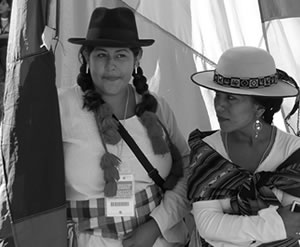
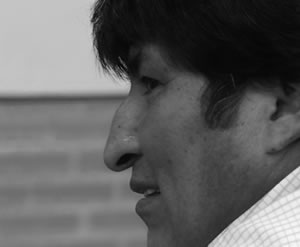
This was my first time in South America and I found it beautiful. Cochabamba is in the foothills of the Andes, surrounded by high, lush green hills. The flight there from La Paz is over the Andes and the views are breathtaking. The conference itself was an inspiration, although it was something of a rollercoaster ride. The caring, the enthusiasm, the resourcefulness and the commitment of the people involved were obvious and contagious. But, like any reflection on climate change and the environment these days, at times it was rather discouraging. Two things that struck me from the start I found immensely encouraging. This was definitely a “people’s” conference. Representatives from all over the world and from diverse areas, government officials, environmental and climatological scientists, NGO representatives and militant environmentalists stood side by side. And indigenous peoples were front and centre. The Plurinational State of Bolivia has a majority indigenous population and, of course, Evo Morales Ayma, our host for the event, is himself Ayamara and the colourful Ayamara flag was everywhere in evidence at the opening ceremonies and throughout the event.
Bien Vivir
In April, I had the good fortune of attending the World People’s Conference on Climate Change and the Rights of Mother Earth. The conference took place in Tiquipaya, a few kilometers outside the Bolivian city of Cochabamba.
This was my first time in South America and I found it beautiful. Cochabamba is in the foothills of the Andes, surrounded by high, lush green hills. The flight there from La Paz is over the Andes and the views are breathtaking. The conference itself was an inspiration, although it was something of a rollercoaster ride. The caring, the enthusiasm, the resourcefulness and the commitment of the people involved were obvious and contagious. But, like any reflection on climate change and the environment these days, at times it was rather discouraging. Two things that struck me from the start I found immensely encouraging. This was definitely a “people’s” conference. Representatives from all over the world and from diverse areas, government officials, environmental and climatological scientists, NGO representatives and militant environmentalists stood side by side. And indigenous peoples were front and centre. The Plurinational State of Bolivia has a majority indigenous population and, of course, Evo Morales Ayma, our host for the event, is himself Ayamara and the colourful Ayamara flag was everywhere in evidence at the opening ceremonies and throughout the event.
 The conference included seventeen working groups, each with
a specific focus. The conclusions of all of them have been integrated into
the document we publish here. In addition there were panel discussions on issues
such as The Structural Causes of Climate Change, Climate Justice, The ABC of
Climate Change Negotiations and several others.
The conference included seventeen working groups, each with
a specific focus. The conclusions of all of them have been integrated into
the document we publish here. In addition there were panel discussions on issues
such as The Structural Causes of Climate Change, Climate Justice, The ABC of
Climate Change Negotiations and several others.A UN Charter of the Rights of Mother Earth, an International
Court of Environmental Justice, and a clear articulation of the nature of Climate
Debt are three of the most dramatic points the Bolivian delegation, and the
movement that has grown out of the conference, will be bringing to Cancún,
Mexico. That is the site of the next meeting of the UN Framework Convention
on Climate Change (UNFCCC) at the end of this year. Equally important are the
issues of water, food and agricultural sovereignty, sovereignty in the management
of forests and, indeed, of all natural resources. It behooves all of us to
follow the process of moving these issues
towards Cancún and to participate where we can. Useful links in that regard are provided at the end of this piece.
towards Cancún and to participate where we can. Useful links in that regard are provided at the end of this piece.
The day after my return from Bolivia, I found myself in an
underground mall in the area of Peel street, in Montreal. Faced with the overwhelming
opulence of what was on offer, I literally felt sickened. The fact is that
having gone to this conference in South America, I will never get all the way
back. I will no longer be able to pretend I don’t know that our extravagant
consumption is at the expense of the resources of the majority world. In that
mall, I was reminded one of the most obscenely arrogant
pronouncements I have ever heard: “The American way of life is not negotiable.”, first
proclaimed by George H.W. Bush, at the Earth Summit in 1992, and repeated by
both Bush Jr. and Dick Cheney. Well guess what: it is negotiable and the negotiations
have started. On the other side of the table, so to speak, is Mother Earth.
More intransigent than any government and more powerful than any army, she
will win.
An economic system based on continuous growth cannot continue
to exist in a world of limited resources. Things do not have to, indeed, cannot
continue as they are. We cannot continue to spew methane, black carbon and
CO2 into the atmosphere. We must bring to an end our dependence on fossil fuels
and we must do it quickly. As someone said at the conference, and I wish I
could remember who to credit: “We didn’t move out
of the Stone Age because we ran out of stones.”
As a substitute to a way of life based on “bigger, better,
faster, more”, many at the conference, particularly
from the indigenous community, proposed the idea of bien
vivir, living well
as opposed to always striving to live better. In a sense, this idea underlay the entire tone and
atmosphere of the conference. And it felt good and it felt right.
PS: The new draft negotiating text, (presented at the interim
climate change conference in Bonn this June), ignores these Cochabamba agreements
and instead incorporates ALL of the components of the Copenhagen Accord. Much
remains to be done before the end of the year.
| * |
Usually in this space I comment on content. Instead, in this
issue, I would like to appeal for submissions. This is your magazine, the magazine
of Canada’s
humanist community. It should be as good, as intelligent, as articulate as
the community that reads and supports it and usually it is. But there are a
number of issues I think it important for us to consider and I’m not
receiving submissions that deal with them. If you have strong and informed
opinions on any of the following issues, I urge you to submit an article, or
at the very least a letter.
In the near future I would like the subject of end-of-life
explored. How do we deal with the elderly? Is the primary purpose of end-of-life
medicine to forestall death as long as possible? What should end-of-life health
care entail? How should it be practiced? If you have any knowledge and experience
either as a health care professional
or as a person with an elderly parent or relative, share your experiences and ideas with us.
or as a person with an elderly parent or relative, share your experiences and ideas with us.
Many First Nations communities across this country continue
to experience more than their share of social ills. We hear about high suicide
rates, inadequate housing, high rates of criminalization, substance abuse,
the depredation of vital natural resources. We also hear about resourceful
and successful initiatives in many of these areas. If you are from a First
Nations community or otherwise have experience of any of these things, positive
or negative, let us know.
What is going on inside our prison system? Are Canadians well
informed concerning how the portion of our money that goes to the prison system
is spent and to what effect? Do we have any idea about the human problems present
in the prison system and how they are dealt with?
Why is AA, a religion-based twelve-step program, still the
dominant program for the treatment of alcoholics and other addicts, one to
which the courts routinely refer perpetrators of alcohol-related offences?
Is there not a secular,
humanist treatment alternative and if not, why not? Do you have experience with AA? Do you have experience with alternative programs? Share your thoughts.
humanist treatment alternative and if not, why not? Do you have experience with AA? Do you have experience with alternative programs? Share your thoughts.
These are just some of the questions I would like to see addressed
in future issues. This is a magazine for progressive, thoughtful, humanist
readers. Help keep the content worthy of our intellectually astute and curious
readership by becoming a contributor yourself. I look forward to hearing from
you.
—Yves Saint-Pierre